%20(1).png)
5 high-impact B2B sales workflows for complex teams
Discover the 5 key B2B sales workflow types, from MEDDIC to AI-driven signal-based flows, and learn how to choose and implement the right one for your complex sales team.
TL;DR:
- Top performers use structured workflows, achieving higher win rates and revenue.
- Qualification frameworks like MEDDIC reduce late-stage deal failures by surfacing risks early.
- AI-driven workflows offer real-time insights, accelerating deal velocity and improving forecast accuracy.
Not all B2B sales cycles are created equal. In complex organizations managing broad service portfolios, the gap between top performers and average reps often comes down to one thing: workflow discipline. Top performers are 588% more likely to use structured methodologies, achieving 27% higher win rates. Yet most sales leaders still rely on informal, inconsistent processes that leave revenue on the table. This article maps the major B2B sales workflow types, compares their strengths, and gives you a practical decision framework to choose and adapt the right approach for your team.
Table of Contents
- Core sales workflow types in B2B teams
- Deep dive: Qualification-first workflows (e.g., MEDDIC, SPICED)
- Execution frameworks: Challenger, SPIN, and consultative selling
- AI-driven signal-based workflows: The new paradigm
- Comparison of major B2B sales workflow types
- Why perfect workflows fail—and what actually powers B2B sales
- Accelerate your workflow transformation with Uman
- Frequently asked questions
Key Takeaways
PointDetailsStructured workflows winTeams using qualification and execution frameworks drive up to 27 percent higher win rates and greater revenue growth.AI accelerates outcomesAI-driven, signal-based workflows reduce cycles and surface risks, boosting close rates by up to 30 percent.No one-size-fits-allThe best workflow for your team depends on deal complexity, sales cycle length, and organizational maturity.Iterate for impactContinuous feedback and adaptation unlock the real value of any sales workflow.
Core sales workflow types in B2B teams
Understanding the importance of a defined sales process is the first step. But knowing which type of process to build is what separates well-intentioned teams from genuinely high-performing ones.
In B2B sales, a workflow is more than a checklist. It is a structured sequence of actions, decisions, and handoffs that guide a rep from first contact to closed deal. The right workflow reduces guesswork, shortens cycle times, and creates repeatable results across your entire team.
Here are the four primary workflow types used by high-performing B2B organizations:
- Stage-based (linear) workflows: These map the sales process to defined pipeline stages, such as prospecting, discovery, proposal, and close. Each stage has entry and exit criteria. They are easy to implement and track in a CRM, making them ideal for teams new to structured selling.
- Qualification-first workflows: Built around frameworks like MEDDIC or MEDDPICC, these workflows front-load the process with rigorous qualification. Reps assess metrics, economic buyers, decision criteria, and pain before investing significant time in a deal.
- Execution and consultative frameworks: Methodologies like Challenger and SPIN Selling focus on how reps engage buyers. They emphasize insight-led conversations, reframing buyer assumptions, and diagnosing needs before pitching solutions.
- AI-driven signal-based workflows: The newest category. These workflows use real-time data signals, such as buyer intent, email engagement, and CRM activity patterns, to dynamically prioritize actions and surface next-best steps.
“Sales teams using formal methodologies see 27% higher win rates and an 18% revenue lift.”
Each workflow type has a distinct purpose. Stage-based flows create visibility. Qualification frameworks protect pipeline quality. Execution frameworks improve buyer engagement. AI-driven flows accelerate velocity. The most effective teams do not pick just one. They layer them intentionally.
Deep dive: Qualification-first workflows (e.g., MEDDIC, SPICED)
Qualification-first workflows are built on a simple but powerful premise: not every opportunity deserves your team’s time. By filtering aggressively at the front of the funnel, these frameworks protect your pipeline from low-quality deals that stall late and drain resources.
What defines a qualification-first workflow? It prioritizes evidence gathering before commitment. Reps must confirm specific criteria before a deal advances. This is not about being selective for its own sake. It is about ensuring that every deal in your pipeline has a realistic path to close.
Here is how the steps typically unfold in MEDDIC:
- Metrics: Quantify the economic impact of solving the buyer’s problem. What does success look like in numbers?
- Economic buyer: Identify who controls the budget and has final authority. Many deals stall because reps never reach this person.
- Decision criteria: Understand the formal and informal factors that will drive the buying decision.
- Decision process: Map the steps the buyer will follow internally before signing.
- Identify pain: Confirm the business pain is real, urgent, and tied to measurable consequences.
- Champion: Find and develop an internal advocate who will sell on your behalf when you are not in the room.
SPICED, used widely in SaaS and services, follows a similar logic: Situation, Pain, Impact, Critical event, and Decision. It adds a time dimension by anchoring qualification to a critical event, a deadline or trigger that creates urgency.
Why do these frameworks reduce late-stage deal loss? Because they surface risk early. A deal that lacks a clear economic buyer or a defined decision process is a deal that will likely stall. Qualification frameworks force that conversation before you invest weeks of effort.
For teams focused on qualifying B2B leads more effectively, integrating qualification with execution drives 20 to 30% higher close rates. That is not a marginal improvement. It is a structural shift in how your pipeline performs.
Pro Tip: Do not treat qualification as a one-time gate. Revisit MEDDIC criteria at every major stage transition. Buyer circumstances change, and a deal that was well-qualified in month one may have shifted significantly by month three.
For a broader view of B2B sales best practices, qualification discipline consistently ranks as one of the highest-leverage behaviors separating top quartile teams from the rest.
Execution frameworks: Challenger, SPIN, and consultative selling
Qualification sets the foundation. Execution frameworks determine what happens once you are in front of the right buyer. This is where deals are won or lost at the conversation level.

Challenger selling is built on research showing that the most effective reps do not just respond to buyer needs. They teach, tailor, and take control. A Challenger rep opens with a provocative insight about the buyer’s business, reframes how the buyer sees their problem, and then positions their solution as the logical answer to that reframed problem.
SPIN Selling takes a diagnostic approach. Reps ask four types of questions in sequence:
- Situation questions: Establish context about the buyer’s current state.
- Problem questions: Surface explicit challenges the buyer is experiencing.
- Implication questions: Explore the downstream consequences of those problems.
- Need-payoff questions: Help the buyer articulate the value of solving the problem.
The power of SPIN is that it leads buyers to their own conclusions. The rep does not push a solution. The buyer arrives at it through guided discovery.
Both frameworks work best when they follow, rather than replace, rigorous qualification. There is little value in delivering a brilliant Challenger pitch to a buyer who has no budget authority or no real urgency. This is why sales execution frameworks are most effective when layered on top of qualification discipline.
Top-performing teams combine MEDDIC qualification with Challenger and SPIN execution to raise close rates by 20 to 30%. The combination also reduces stalled deals because reps are engaging the right people with the right message at the right time.
Another practical benefit: execution frameworks naturally encourage multi-threading. When reps use Challenger or SPIN, they often need to engage multiple stakeholders to gather implications and validate insights. This builds broader relationships within the account and reduces single-threaded deal risk.
Pro Tip: Map your execution framework to your buyer’s journey, not your internal sales stages. Buyers do not care about your CRM pipeline. They care about their own decision process. Align your Challenger or SPIN sequence to where the buyer is mentally, not where your deal sits in a stage.
For teams working to improve lead qualification improvements, combining qualification and execution frameworks is the fastest path to consistent, repeatable results.
AI-driven signal-based workflows: The new paradigm
As deal complexity rises, static workflows struggle to keep pace. A stage-based process tells you where a deal is. An AI-driven signal-based workflow tells you what is actually happening inside the deal, and what to do next.
Signal-based workflows replace fixed stage gates with dynamic, real-time intelligence. Instead of advancing a deal because a rep checked a box, the system monitors signals: email response rates, stakeholder engagement patterns, intent data from the buyer’s website activity, and CRM interaction frequency. When signals shift, the workflow adapts.
AI-driven workflows prioritize high-intent accounts 3.4x faster than traditional stage-based approaches. That speed advantage compounds across a large pipeline.
“The shift from static stages to signal-based workflows is not just a technology upgrade. It is a fundamentally different way of understanding where deals stand and what they need.”
Here is how signal-based workflows operate in practice:
Signal typeWhat AI detectsWorkflow responseBuyer intentProspect visits pricing or competitor pagesTriggers urgent outreach playbookEngagement dropNo stakeholder response in 7 daysSurfaces re-engagement prompt for repChampion riskKey contact changes roles or leavesAlerts rep to multi-thread immediatelyDeal velocityDeal moving slower than peer benchmarksFlags for manager review and coaching
For teams exploring AI strategies in B2B sales, signal-based workflows represent the clearest path to reducing cycle length and improving forecast accuracy. They also support AI prospecting for efficiency by surfacing the accounts most likely to convert before reps invest significant time. The broader impact on sales efficiency is measurable: shorter cycles, fewer surprises, and more confident pipeline calls.
Comparison of major B2B sales workflow types
Top teams using formal or AI-driven workflows consistently outperform peers on velocity, win rates, and quota attainment. But the right choice depends on your context. Here is a side-by-side view to guide your decision, and be sure to also consider the pitfalls of AI in sales before committing to a fully automated approach.
Workflow typeBest use caseKey advantagePotential pitfallAI compatibilityStage-basedEarly-stage or growing teamsSimple to implement and trackCan become checkbox exerciseMediumQualification-first (MEDDIC)Complex, high-value dealsProtects pipeline qualityCan slow early-stage momentumHighExecution (Challenger/SPIN)Competitive, insight-driven salesImproves buyer engagementRequires skilled, trained repsMediumAI signal-basedHigh-volume or complex pipelinesReal-time adaptabilityRequires clean, connected dataNative
Why perfect workflows fail—and what actually powers B2B sales
Here is something most workflow guides will not tell you: a perfectly designed workflow can still fail spectacularly. We have seen it happen. Teams invest in MEDDIC training, roll out a new CRM configuration, and then watch adoption collapse within 90 days because the workflow was designed for the process, not for the people.
The most common failure modes are not technical. They are cultural. Over-automation removes the judgment that experienced reps bring to complex deals. Rigid adherence to a framework turns dynamic buyer conversations into scripted interrogations. And when sales, marketing, and customer success do not share a common workflow language, the handoffs break down exactly where they matter most.
Why process discipline matters is not just about following steps. It is about building a learning loop. The teams that sustain performance over time treat their workflow as a living system. Frontline reps feed insights back into the process. Managers coach to the workflow, not around it. AI systems are calibrated continuously against real deal outcomes.
The most overlooked lever in B2B sales is the feedback loop between your people and your systems. Workflows do not win deals. People using well-designed workflows, with the right support and the right data, win deals.
Accelerate your workflow transformation with Uman
If you are ready to move beyond generic sales processes and build workflows that actually match the complexity of your deals, Uman is built for exactly that challenge.
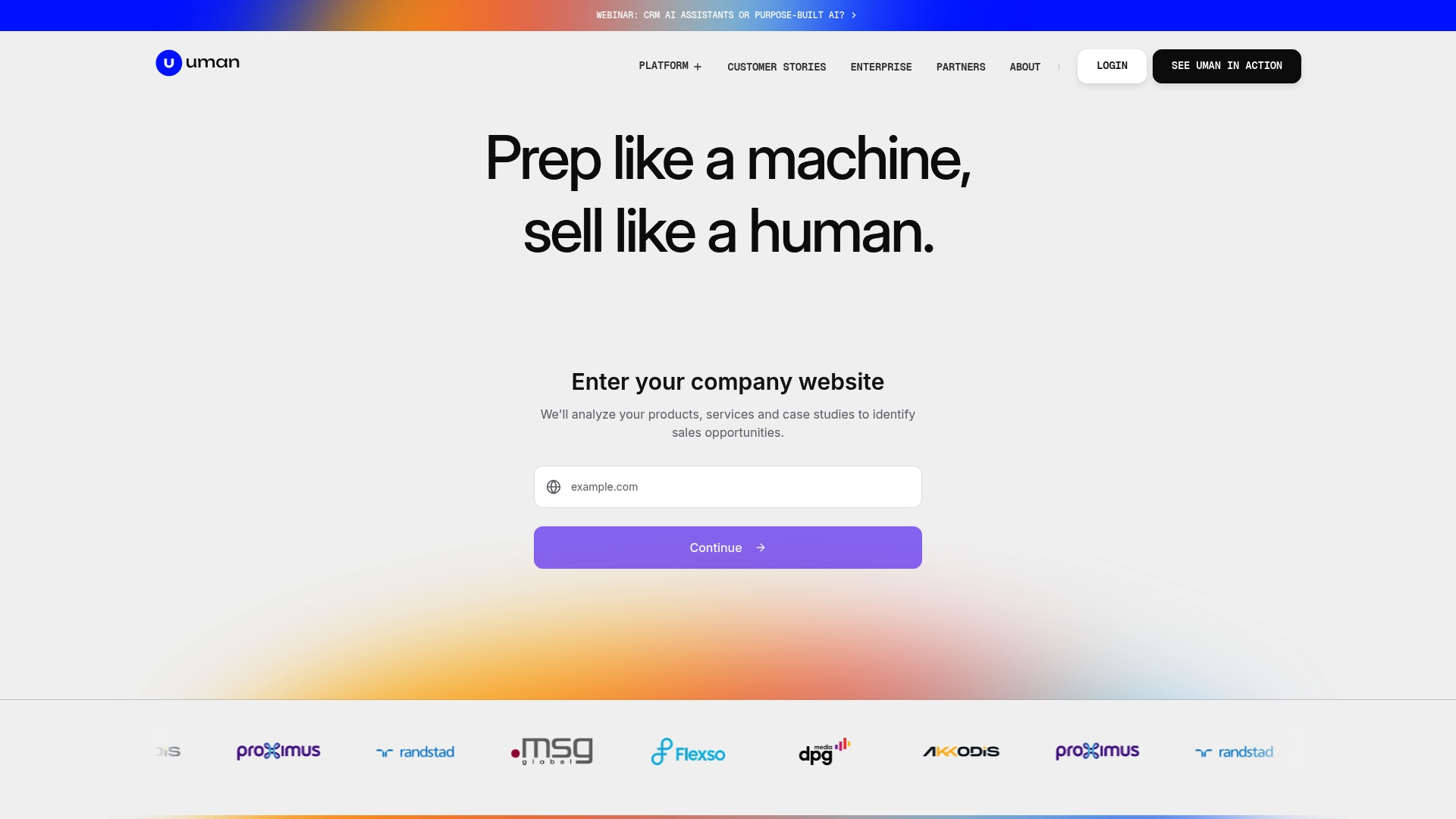
The Uman platform acts as a centralized sales brain, mapping your service portfolio to structured, AI-powered workflows across every stage of the cycle. From deal execution tools that support meeting preparation, qualification, and CRM updates, to account management capabilities that surface cross-sell and upsell opportunities in real time, Uman operationalizes the frameworks covered in this article. Organizations using Uman report 10% to 30% revenue increases within 12 to 18 months. Explore the platform or book a demo to see how your team can put these workflows into practice.
Frequently asked questions
What is the most effective B2B sales workflow for complex deals?
The most effective approach combines rigorous qualification frameworks like MEDDIC with adaptive execution and AI-driven signal detection. Integrating these layers consistently boosts close rates and accelerates deal velocity in complex B2B environments.
How do AI-driven sales workflows improve win rates?
AI-driven workflows automatically detect deal signals and adapt playbooks in real time. High-intent accounts are prioritized 3.4x faster, reducing wasted effort and improving win rates across the pipeline.
Can traditional sales processes compete with AI-based workflows?
Traditional, static workflows are increasingly outpaced in complex B2B sales. AI workflows enable dynamic adaptation to buyer intent and engagement signals that static stage-based processes simply cannot detect or respond to in time.
How do I choose the right workflow for my team?
Evaluate your deal complexity, average deal size, and the number of stakeholders involved. Stage-based workflows suit simpler cycles, qualification-first frameworks fit high-value complex deals, and AI-driven workflows deliver the most value when you have the data infrastructure to support real-time signal detection.
Recommended
Prep like a machine, sell like a human
Let AI handle the research and prep work — you focus on building relationships and closing deals.