%20(1).png)
How CRM transforms B2B sales success: strategies & impact
Discover how CRM drives B2B sales success through process enforcement, pipeline visibility, and measurable ROI. Practical strategies for sales leaders.
Most sales leaders know their CRM system exists. Far fewer use it as the strategic engine it was designed to be. The common misconception is that CRM is a digital filing cabinet, a place to store contacts and log calls. In reality, a well-implemented CRM enforces your sales methodology, creates pipeline visibility, and drives measurable revenue outcomes. Strong ROI benchmarks exist, but only when implementation is treated as a process discipline challenge, not a software rollout. This guide covers what CRM actually does in complex B2B environments, which features matter most, and how to drive adoption that sticks.
Table of Contents
- Why CRM matters in complex B2B sales
- Core CRM features that drive B2B sales efficiency
- Quantifiable impact of CRM on B2B sales performance
- Maximizing CRM adoption for sustainable results
- The uncomfortable truth: CRM success is about process, not technology
- Explore CRM solutions to elevate your B2B sales
- Frequently asked questions
Key Takeaways
PointDetailsCRM amplifies sales processCRM platforms reinforce sales methodology and drive higher win rates only when process discipline is enforced.Adoption trumps featuresUser buy-in and clear workflows matter more for ROI than adding new CRM functionalities.ROI is measurableCRM systems deliver quantifiable improvements in deal velocity, forecast accuracy, and revenue uplift for B2B organizations.Pitfalls are avoidableMost CRM failures can be avoided by prioritizing process enforcement over chasing feature overload.Solutions are evolvingAdvanced platforms like Uman help sales teams adopt CRM best practices and sustain long-term gains.
Why CRM matters in complex B2B sales
A CRM system, or customer relationship management platform, is often described as a tool for organizing contacts and tracking deals. That definition undersells it significantly. In complex B2B sales, where buying cycles stretch across months, involve multiple decision-makers, and require coordinated effort across teams, CRM functions as the connective tissue of your entire revenue operation.
Think about what actually slows down B2B sales teams. Fragmented communication between reps and account managers. No shared visibility into where a deal stands. Inconsistent follow-up because reminders live in someone’s inbox. These are process failures, not technology failures. CRM addresses them by creating a single source of truth that every stakeholder can access and act on.
Following CRM best practices in B2B means treating your platform as a process enforcer, not just an information repository. When reps are required to log activity, update deal stages, and document stakeholder interactions, the data becomes reliable. Reliable data enables accurate forecasting. Accurate forecasting enables better resource allocation and faster decisions.
The core value CRM delivers in complex B2B environments includes:
- Stakeholder mapping: Track every contact involved in a buying decision and their influence level
- Pipeline visibility: Give sales leaders a real-time view of deal health across the entire team
- Process adherence: Enforce stage gates and qualification criteria so no deal advances without the right evidence
- Collaboration support: Connect reps, pre-sales, and account managers around shared deal context
- Forecasting discipline: Replace gut-feel projections with data-driven pipeline analysis
“The organizations that see the strongest CRM ROI are those that treat implementation as a methodology challenge, not a feature deployment.” This insight from The TEI Of Salesloft reflects what top-performing sales teams already know: the platform matters less than the process it enforces.
Improving sales process improvements through CRM also means higher win rates. When reps follow a consistent qualification and engagement process, outcomes become more predictable. That predictability is what separates high-performing B2B sales organizations from those that rely on heroic individual efforts.
Core CRM features that drive B2B sales efficiency
Not all CRM features deliver equal value in complex B2B environments. Sales leaders need to be selective about which capabilities they prioritize and enforce. Here are the features that consistently move the needle:
- Lead and deal tracking: Every opportunity should have a clear owner, stage, and next action. This eliminates the ambiguity that causes deals to stall.
- Pipeline management: Visual pipeline views allow managers to spot bottlenecks and coach reps on specific stuck deals rather than relying on status update meetings.
- Automated reminders and follow-ups: Reps who manage 30 or more active opportunities cannot rely on memory. Automated triggers ensure no follow-up falls through the cracks.
- Document and contract management: Centralizing proposals, contracts, and supporting materials inside the CRM reduces version confusion and speeds up deal closure.
- Reporting and forecasting: Dashboards that surface deal velocity, stage conversion rates, and rep activity give leaders the data they need to intervene early.
Pro Tip: Before activating every feature your CRM offers, map your actual sales stages first. Then configure only the fields and automations that correspond to real steps in your process. Feature overload is one of the fastest ways to kill adoption.
The difference between a generic CRM and an advanced one becomes clear when you look at what each actually supports:
CapabilityGeneric CRMAdvanced CRMDeal trackingBasic stage loggingStage-gated with required fieldsPipeline visibilityStatic list viewsDynamic dashboards with alertsFollow-up automationManual remindersTriggered sequences based on deal behaviorForecastingManual entryAI-assisted probability scoringIntegrationLimited connectorsNative CRM and DMS integration
Effective CRMs enhance visibility, accountability, and adherence to sales methodologies, which is why advanced configuration matters more than raw feature count. Using a complex sales process checklist alongside your CRM setup helps ensure every stage reflects real buyer behavior. Pairing that with strong lead qualification strategies means your pipeline data stays clean and actionable from the start.

Quantifiable impact of CRM on B2B sales performance
Sales leaders need more than promises. They need numbers. The evidence for CRM impact in B2B environments is consistent across multiple studies and real-world deployments.
Strong ROI benchmarks emerge when CRM is implemented with methodology enforcement at its core. Organizations that treat CRM as a process discipline tool, rather than a data entry system, consistently report measurable improvements across key performance indicators.
Here is what the data typically shows before and after structured CRM adoption:
MetricBefore CRM adoptionAfter CRM adoptionForecast accuracy55-65%75-85%Average deal cycle lengthBaselineReduced by 15-25%Rep time on admin tasks30-40% of weekReduced by 10-15%Win rate on qualified dealsBaselineImproved by 10-20%Cross-sell identificationAd hocSystematic and measurable
These figures reflect what happens when CRM adoption is paired with process enforcement. The platform does not create the improvement on its own. It creates the conditions for consistent behavior, and consistent behavior produces better outcomes.
The KPIs most directly affected by CRM adoption in complex B2B sales include:
- Deal velocity: How quickly opportunities move through each stage
- Win rate: The percentage of qualified deals that close successfully
- Forecast accuracy: How closely projected revenue matches actual results
- Pipeline coverage: The ratio of pipeline value to quota, which signals future revenue health
- Activity-to-outcome ratios: Which rep behaviors correlate most strongly with closed deals
Exploring revenue boosting strategies alongside CRM implementation gives sales leaders a clearer picture of where to focus. The goal is not just to track activity but to understand which activities drive results. That understanding comes from clean, consistent CRM data over time. Teams focused on optimizing the sales cycle find that CRM-enforced stage discipline is often the single biggest lever available to them.
Maximizing CRM adoption for sustainable results
The most common reason CRM investments underperform is not a technology problem. It is an adoption problem. Reps who do not trust the system, do not understand why it matters, or feel it adds work without adding value will find ways around it. The result is incomplete data, unreliable forecasts, and a CRM that becomes a compliance burden rather than a sales asset.
The most frequent adoption pitfalls include feature overload, where teams are asked to fill in dozens of fields that no one ever uses, and lack of process discipline, where CRM usage is optional rather than embedded in how deals are managed.
Steps that consistently improve CRM adoption across complex B2B sales teams:
- Start with process, not configuration: Define your sales stages and required behaviors before touching the CRM setup
- Identify process champions: Designate senior reps who model correct CRM usage and help peers troubleshoot
- Create feedback loops: Give reps visibility into how their CRM data is used in forecasting and coaching
- Reduce friction: Eliminate fields that serve reporting needs but add no value to the rep’s daily workflow
- Connect CRM to coaching: Use pipeline reviews and deal inspection sessions to reinforce that CRM data drives real conversations
Pro Tip: Align CRM completion with sales incentives. When reps see that accurate pipeline data leads to better coaching, faster approvals, and more relevant support, adoption becomes self-reinforcing rather than manager-driven.
Sales leaders should focus on adoption via methodology enforcement, not chasing the next feature release. Pairing CRM discipline with effective prospecting in B2B ensures your pipeline starts clean. Business development automation can further reduce the manual burden, and following a solid B2B sales compliance guide keeps your data practices audit-ready.
The uncomfortable truth: CRM success is about process, not technology
Here is something most CRM vendors will not tell you: the platform is almost irrelevant if your sales process is not enforced. We have seen organizations with enterprise-grade CRM systems producing worse outcomes than smaller teams using basic tools with rigorous process discipline.
Technology amplifies what leadership enforces. If your sales methodology is inconsistently applied, CRM will amplify that inconsistency. If your reps are not held accountable for pipeline hygiene, no dashboard will fix that.
Most CRM failures trace back to the same root cause: leaders treated the rollout as an IT project rather than a behavioral change initiative. The software went live. The process transformation never happened.
What senior leaders in high-performing organizations actually do is different. They operationalize CRM best practices through inspection, coaching, and incentive alignment. They make CRM the language of their pipeline reviews. They treat incomplete data as a process failure, not a system limitation. Methodology enforcement is the variable that separates teams that see strong CRM ROI from those that keep waiting for the next feature update to solve their problems.
Explore CRM solutions to elevate your B2B sales
Understanding CRM’s strategic value is the first step. Putting it into practice requires the right tools and the right approach to process enforcement.
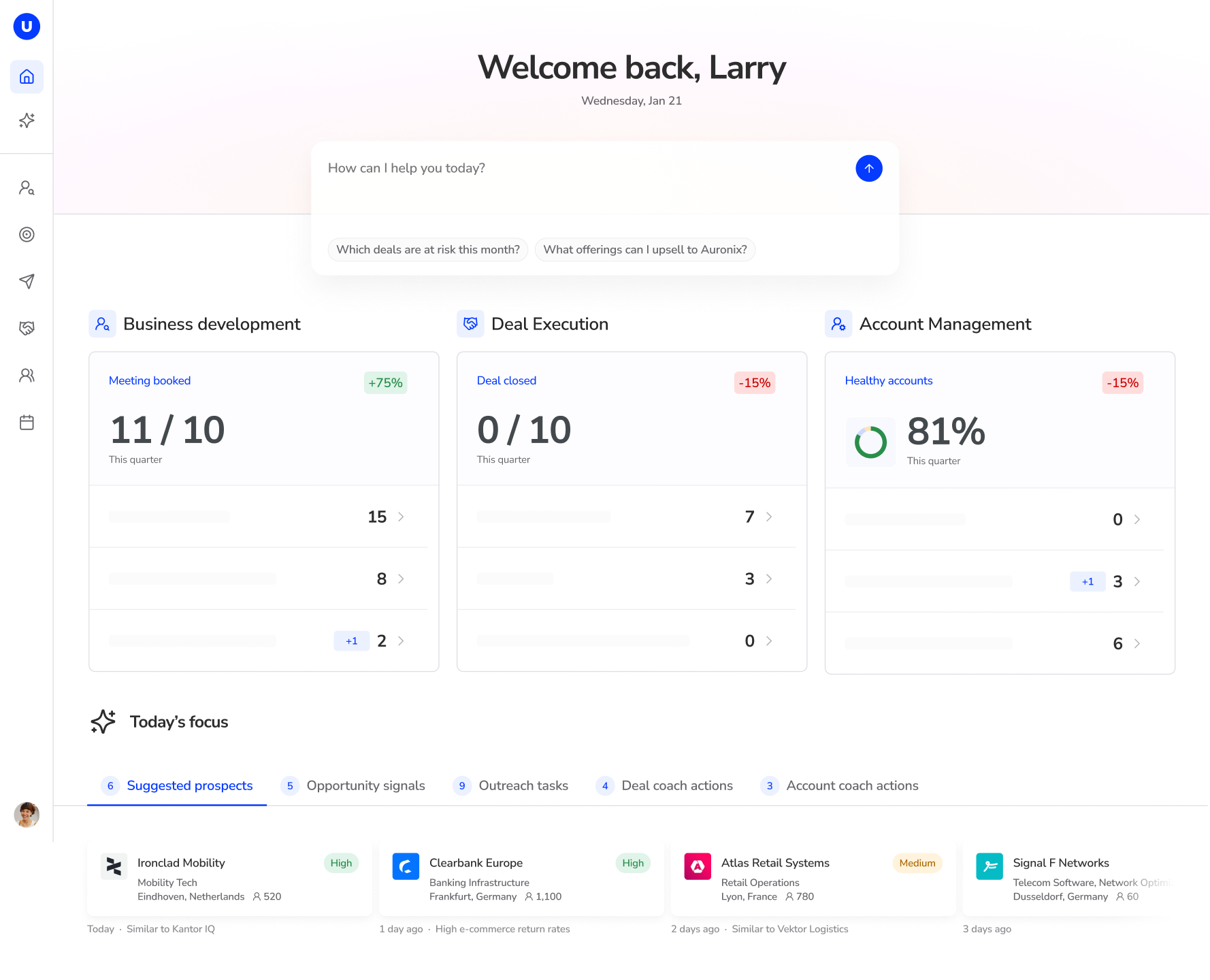
Uman’s platform is built specifically for complex B2B sales organizations that need more than a contact database. It centralizes sales knowledge, automates guided workflows, and integrates directly with your existing CRM to reduce administrative burden while strengthening process discipline. Explore the account management tools to see how cross-sell and upsell opportunities surface automatically, or review the deal execution solutions to understand how structured workflows accelerate deal velocity and improve win rates across your team.
Frequently asked questions
What is the single most important factor for CRM success in B2B sales?
Process enforcement and team buy-in matter more than technology features for sustainable CRM impact. Without methodology discipline, even the most advanced platform will underperform.
How does CRM improve forecasting accuracy in B2B sales?
CRM provides real-time data visibility across complex pipelines and enforces standardized input, making forecasts more reliable. Effective CRMs enhance visibility and accountability in ways that manual tracking simply cannot match.
What are common obstacles to CRM adoption?
Feature overload and lack of adherence to process are the most frequent causes of CRM failure. When reps see CRM as a data entry burden rather than a tool that helps them sell, adoption stalls quickly.
Can CRM solutions help manage compliance in B2B sales?
Yes. CRMs with process enforcement improve data auditability and compliance adherence across accounts. Enhanced visibility and accountability make it easier to demonstrate consistent, documented sales practices during audits.
Which KPIs are most impacted by CRM adoption?
Deal velocity, win rates, and forecast accuracy are most influenced by CRM implementation in B2B sales. Strong ROI benchmarks consistently point to these three metrics as the primary indicators of CRM-driven performance improvement.
Recommended



Prep like a machine, sell like a human
Let AI handle the research and prep work — you focus on building relationships and closing deals.