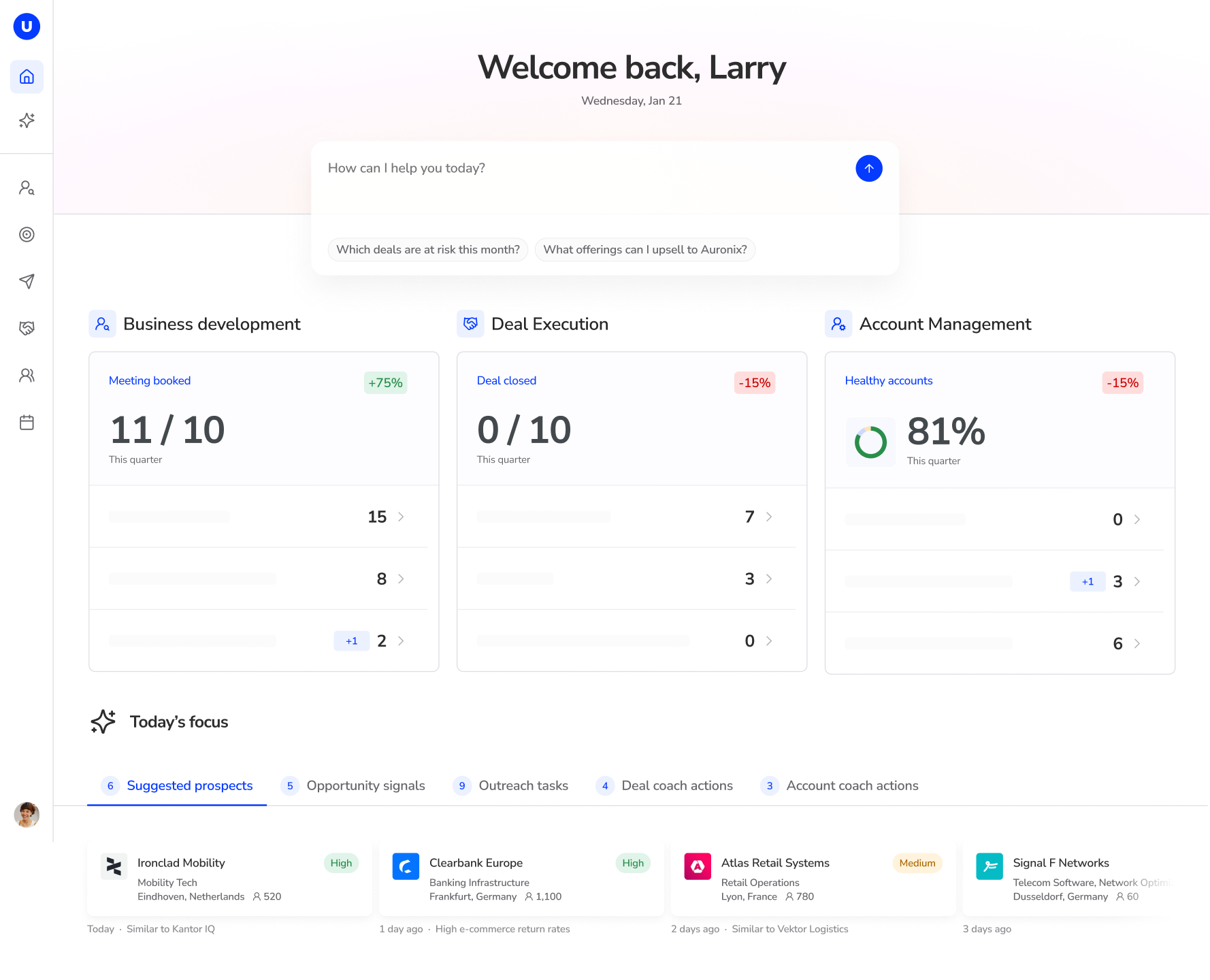
%20(1).png)
How AI boosts sales efficiency for B2B leaders
Discover how AI drives measurable sales efficiency gains for B2B leaders through proven strategies, data-backed insights, and practical implementation frameworks.
Sales leaders hear constantly about AI’s transformative potential, yet many complex B2B organizations struggle to translate that promise into measurable efficiency gains. The gap isn’t about technology availability. Research shows that sales managers’ capabilities and knowledge-sharing culture determine whether AI actually improves sales performance. This guide reveals how top-performing B2B sales teams leverage AI to drive efficiency, backed by empirical data and practical frameworks you can implement immediately.
Table of Contents
- Key takeaways
- Understanding how AI enhances sales efficiency in B2B
- How AI technologies drive measurable efficiency and sales performance gains
- Navigating managerial and cultural nuances for successful AI adoption in sales
- Practical steps for sales leaders to leverage AI for efficiency and growth
- Explore Uman’s AI platform for sales efficiency
- FAQ
Key Takeaways
PointDetailsManagerial AI capabilitiesSales leaders must develop fluency in tool selection, implementation, and performance measurement to unlock efficiency gains from AI.Knowledge sharing cultureOrganizations that prioritize collaborative learning and information exchange integrate AI more quickly into workflows and improve adoption.Positive AI mindsetViewing AI as augmentation and fostering psychological safety enables experimentation and iterative improvement.Integrated knowledge processesCentralizing customer interactions, product insights, and market intelligence allows AI to surface actionable recommendations rather than operate in isolation.AI readiness impactAn AI readiness assessment highlights gaps in managerial capabilities and knowledge culture and shows how high readiness accelerates gains by 2 to 3 times.
Understanding how AI enhances sales efficiency in B2B
The relationship between AI and sales efficiency isn’t automatic. Your sales managers play a pivotal role in unlocking AI’s potential. Sales managers’ capabilities foster AI-integrated knowledge processes that directly enhance team efficiency. When managers understand how to orchestrate AI tools within existing workflows, they create multiplicative effects across prospecting, deal execution, and account management.
Three foundational factors determine whether AI delivers efficiency gains in complex B2B environments:
- Managerial AI capabilities: Sales leaders must develop fluency in AI tool selection, implementation, and performance measurement. This goes beyond basic tech literacy to include strategic thinking about which sales processes benefit most from automation versus human expertise.
- Knowledge-sharing culture: Organizations that already prioritize collaborative learning and information exchange see faster AI adoption. Teams comfortable sharing insights, best practices, and customer intelligence integrate AI recommendations more naturally into their workflows.
- Positive AI mindset: Sales professionals who view AI as an augmentation tool rather than a replacement threat engage more deeply with new capabilities. This psychological safety enables experimentation and iterative improvement.
Integrated knowledge processes create the connective tissue between these factors. When your sales team systematically captures customer interactions, product insights, and market intelligence in centralized systems, AI can analyze patterns and surface actionable recommendations. Without this foundation, AI tools operate in isolation, delivering fragmented value at best.
Consider how AI readiness assessment for sales orgs evaluates these dimensions. Organizations scoring high on managerial capabilities and knowledge culture achieve efficiency gains 2-3x faster than those focusing solely on technology deployment. The assessment reveals gaps in your current state and provides a roadmap for building the organizational conditions where AI thrives.
“AI integration success depends less on the sophistication of algorithms and more on the quality of knowledge processes and managerial capabilities that guide their application in sales contexts.” — Research from industrial marketing management studies
This insight challenges the common assumption that buying advanced AI tools automatically improves sales efficiency. The real leverage comes from building high-performing sales teams that combine human judgment with machine intelligence. Your investment in developing these capabilities pays dividends across every AI implementation.
How AI technologies drive measurable efficiency and sales performance gains
Specific AI applications deliver quantifiable improvements across the sales cycle. The data from B2B organizations reveals where efficiency gains concentrate and which technologies produce the highest ROI.
GenAI improves sales effectiveness and administrative efficiency, with 39% gains observed in organizations using AI for both customer-facing and back-office tasks. These improvements manifest in three critical areas:
- Lead scoring and qualification: AI analyzes behavioral signals, firmographic data, and engagement patterns to identify high-potential prospects. This reduces time spent on unqualified leads by 40-50% while improving conversion rates.
- Compliance and documentation: Automated systems ensure proposals, contracts, and communications meet regulatory requirements without manual review. Sales teams save 8-12 hours weekly on administrative tasks.
- Sales cycle acceleration: Predictive analytics identify bottlenecks and suggest optimal next actions, shortening average deal cycles by 15-25% in complex B2B sales.
The empirical evidence supporting these gains comes from diverse industries. Healthcare B2B sales organizations using generative AI for proposal creation, meeting preparation, and follow-up communications report dramatic efficiency improvements. One study tracked sales teams before and after AI implementation, measuring time allocation, deal velocity, and revenue per rep.
MetricPre-AI baselinePost-AI performanceImprovementHours per week on admin tasks18-22 hours8-12 hours45-55% reductionAverage sales cycle length120 days90-102 days15-25% fasterLead qualification accuracy62%84%35% improvementRevenue per sales repBaseline+18-28%Significant lift
Over 60% of B2B companies report measurable sales gains from AI automation of lead scoring and compliance. This adoption rate reflects growing confidence in AI’s ability to handle routine tasks reliably. The technology has matured beyond experimental pilots to become production-ready infrastructure.
Generative AI particularly excels at content creation and personalization. Sales reps use AI to draft customized proposals, generate follow-up emails, and create presentation materials tailored to specific buyer personas. This capability addresses a major efficiency bottleneck in complex B2B sales where each deal requires significant customization.
Pro Tip: Start with high-volume, repetitive tasks when implementing AI. Automating prospecting with AI delivers quick wins that build organizational confidence and fund broader adoption. Track time savings and conversion rate improvements to demonstrate ROI.
The AI sales platform approach integrates multiple capabilities into cohesive workflows rather than deploying point solutions. This architectural choice matters because efficiency gains compound when AI tools share data and insights across the sales cycle. A lead scoring system that feeds into meeting preparation tools that connect to CRM automation creates exponential value.
Navigating managerial and cultural nuances for successful AI adoption in sales
Technology capabilities mean little without the organizational context to support adoption. Many sales leaders underestimate the cultural and managerial shifts required for AI to deliver efficiency gains.
Limited AI adoption often results from lack of sales managers’ capabilities and knowledge processes rather than AI technology itself. Three common barriers prevent organizations from realizing AI’s potential:
- Insufficient managerial AI literacy: Sales leaders lack frameworks for evaluating AI tools, measuring their impact, or integrating them into team workflows. This creates implementation paralysis or misaligned deployments.
- Resistance to knowledge sharing: Sales cultures that reward individual heroics over collaborative learning struggle with AI systems that depend on shared data and insights. Reps hoard information rather than feeding it into collective intelligence systems.
- Overemphasis on routine execution: Organizations optimized for repeatable processes resist the experimentation and adaptation required to discover AI’s highest-value applications.
The distinction between routine and adaptive expertise becomes critical in AI-enabled sales environments. Routine expertise is commoditized by AI, while adaptive expertise grows more valuable. Routine expertise involves executing established playbooks efficiently. AI handles this increasingly well through automation and process optimization.

Adaptive expertise means recognizing when standard approaches fail and creatively reframing problems to find novel solutions. Complex B2B sales increasingly require this higher-order thinking as AI handles routine tasks. Your sales team needs both capabilities, but the balance shifts dramatically.
Developing adaptive expertise requires deliberate practice in ambiguous situations where standard playbooks don’t apply. Sales leaders should create opportunities for reps to experiment with AI tools, fail safely, and share learnings. This builds the organizational muscle memory for continuous improvement.
Four steps accelerate cultural readiness for AI adoption:
- Establish psychological safety around AI experimentation: Make it clear that trying new AI approaches and learning from failures is valued, not punished. Share both successes and instructive failures in team meetings.
- Invest in knowledge infrastructure: Build systems that capture customer insights, competitive intelligence, and sales best practices in formats AI can analyze. This creates the data foundation for intelligent automation.
- Develop AI fluency through hands-on learning: Provide training that goes beyond vendor demos to actual usage in real sales scenarios. Pair experienced reps with AI-curious colleagues for peer learning.
- Align incentives with knowledge sharing: Recognize and reward reps who contribute to collective intelligence systems, not just individual quota attainment. This shifts behavior toward collaborative AI adoption.
Pro Tip: Address AI adoption challenges in sales by focusing first on process clarity before automation. AI amplifies existing processes, whether effective or broken. Fix foundational issues before layering on technology.
The organizations achieving the highest efficiency gains from AI share common cultural characteristics. They view sales as a team sport where shared knowledge multiplies individual capabilities. They embrace experimentation and rapid iteration. They invest in developing both technical and adaptive expertise among sales professionals.
Sales enablement with AI strategies work best when embedded in this cultural foundation. The technology becomes an accelerant for already-strong sales practices rather than a band-aid for dysfunction.
Practical steps for sales leaders to leverage AI for efficiency and growth
Translating AI potential into actual efficiency gains requires a structured implementation approach. Sales and revenue leaders need actionable frameworks that move beyond conceptual understanding to operational reality.
A stepwise framework for integrating AI in sales processes:
- Audit current time allocation: Map how sales reps currently spend their time across prospecting, research, meeting prep, customer interactions, follow-up, and administration. Identify the highest-volume, most repetitive tasks consuming disproportionate time relative to value created.
- Prioritize automation opportunities: Rank tasks by volume, repetitiveness, and strategic importance. Target high-volume, low-strategic-value activities first for AI automation. Reserve human expertise for high-stakes, relationship-intensive moments.
- Select integrated tools over point solutions: Choose AI platforms that connect across the sales cycle rather than isolated tools for individual tasks. Integration multiplies efficiency gains by enabling data flow and compound insights.
- Pilot with willing adopters: Launch AI tools with sales reps who demonstrate curiosity and adaptability. Their early successes and feedback create momentum for broader rollout.
- Measure and iterate: Track specific efficiency metrics like time saved, tasks automated, and conversion rate improvements. Use data to refine AI configurations and expand to additional use cases.
- Scale systematically: Once pilots prove value, roll out AI capabilities team by team with structured training and support. Avoid big-bang deployments that overwhelm users.
The contrast between AI-enabled and traditional approaches reveals where efficiency gains concentrate:
Sales activityTraditional approachAI-enabled approachEfficiency gainLead researchManual web searches, LinkedIn browsingAutomated data aggregation and insight synthesis70% time reductionMeeting preparationCreating custom decks from scratchAI-generated materials from templates and data60% time reductionProposal creationWriting proposals individuallyGenerative AI drafts from requirements55% time reductionCRM updatesManual data entry after callsAutomated capture and classification80% time reductionFollow-up emailsIndividual compositionAI-personalized templates65% time reduction
Over 60% of B2B companies achieve measurable sales gains and two-thirds of revenue leaders see ROI within months using AI. This rapid payback period reflects the maturity of current AI sales tools and the magnitude of efficiency opportunities in typical B2B sales processes.
Quick ROI depends on three factors:
- Clear baseline metrics: Establish current performance on time allocation, conversion rates, and deal velocity before AI implementation. This enables accurate ROI calculation and identifies improvement opportunities.
- Focused initial scope: Resist the temptation to automate everything simultaneously. Target 2-3 high-impact use cases for initial deployment, prove value, then expand.
- Active change management: Technology adoption fails without deliberate attention to training, communication, and behavioral reinforcement. Invest in helping reps understand and embrace new AI-powered workflows.
Pro Tip: Qualifying B2B leads with AI delivers one of the fastest ROI timelines because it sits at the top of the funnel where volume is highest. Improvements here cascade through the entire sales cycle.
Sustainable adoption requires ongoing attention beyond initial implementation. Schedule quarterly reviews of AI tool usage, efficiency metrics, and user feedback. AI capabilities evolve rapidly, so continuous optimization ensures you capture new value as platforms improve.
The deal execution platform features illustrate how integrated AI supports the entire deal lifecycle from qualification through close. Rather than stitching together multiple tools, unified platforms reduce friction and accelerate adoption by providing consistent interfaces and seamless data flow.
Explore Uman’s AI platform for sales efficiency
The strategies and frameworks outlined here come to life through purpose-built platforms designed for complex B2B sales. Uman offers integrated AI solutions specifically engineered to address the efficiency challenges facing sales and revenue leaders in organizations with broad service portfolios.
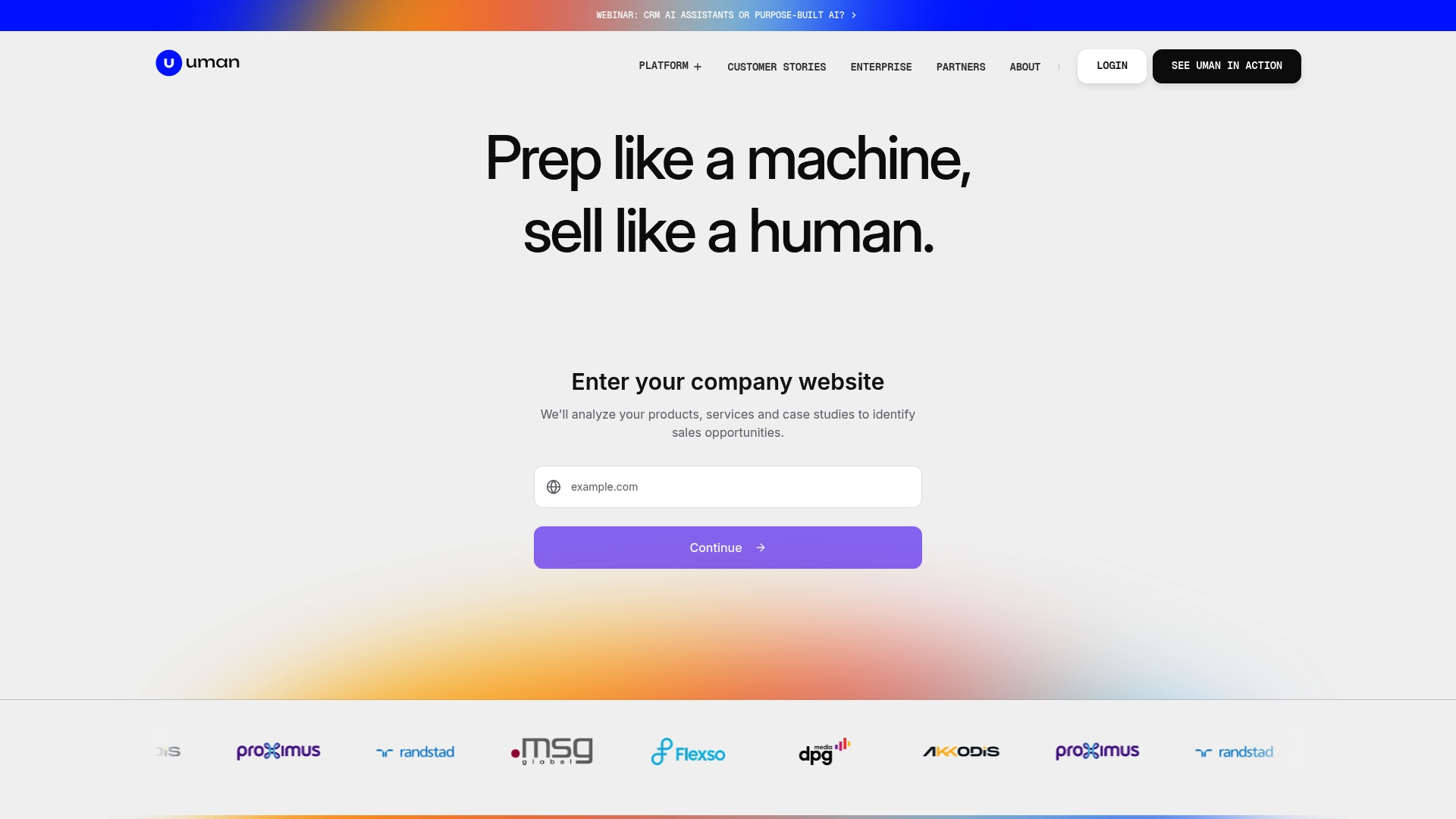
The Uman AI platform centralizes sales knowledge into a governed data layer that powers automated workflows across business development, deal execution, and account management. This architecture eliminates the fragmented tool sprawl that undermines efficiency gains. Sales teams access AI-driven capabilities for meeting preparation, content generation, and opportunity identification through unified interfaces that integrate with existing CRM and document management systems.
Specific modules address the efficiency bottlenecks discussed throughout this guide. The deal execution platform automates qualification, generates customized proposals, and streamlines CRM updates. The account management platform identifies cross-sell opportunities and monitors account health proactively. Together, these capabilities deliver the 10-30% revenue increases observed in organizations that successfully leverage AI for sales efficiency.
FAQ
What specific sales tasks can AI automate?
AI excels at automating lead research and scoring, meeting preparation materials, proposal drafting, CRM data entry, follow-up email composition, and compliance checking. These high-volume, repetitive tasks consume 40-60% of typical sales rep time but create limited strategic value.
How quickly do companies typically see ROI from AI sales tools?
Two-thirds of revenue leaders report measurable ROI within 3-6 months of implementing AI sales tools. Quick wins come from automating administrative tasks and improving lead qualification accuracy. Longer-term gains build as teams develop expertise and expand AI usage.
What cultural changes support successful AI adoption?
Successful AI adoption requires psychological safety for experimentation, knowledge-sharing incentives over individual heroics, and investment in both technical AI literacy and adaptive problem-solving skills. Organizations that view AI as augmentation rather than replacement see faster adoption.
Can AI replace human sales expertise in complex deals?
AI handles routine tasks exceptionally well but cannot replace the adaptive expertise, relationship building, and strategic thinking required in complex B2B sales. The highest-performing teams combine AI efficiency for repetitive work with human judgment for high-stakes decisions and relationship management.
How to measure sales efficiency improvements with AI?
Track time allocation across sales activities, conversion rates at each funnel stage, average deal cycle length, revenue per sales rep, and administrative hours per week. Compare these metrics before and after AI implementation, controlling for market conditions and team composition changes.
What managerial capabilities matter most for AI adoption?
Sales managers need AI tool evaluation frameworks, performance measurement systems, change management skills, and the ability to foster knowledge-sharing cultures. Technical AI expertise matters less than strategic thinking about where AI creates value and how to integrate it into existing workflows.
Recommended

Prep like a machine, sell like a human
Let AI handle the research and prep work — you focus on building relationships and closing deals.