%20(1).png)
AI in B2B prospecting: Streamline sales for greater efficiency
Learn how AI cuts prospecting time by 50% and boosts B2B conversion rates. Discover practical steps to integrate AI into your sales workflow for real results.
TL;DR:
- AI reduces manual prospecting research time by over 50 and improves lead quality.
- Human oversight remains essential for complex B2B deals despite AI automation advances.
- Effective AI adoption depends on high-quality data, proper workflow integration, and structured review processes.
Manual prospecting eats up more selling time than most sales leaders realize. When AI reduces manual research by over 50%, the math becomes impossible to ignore. Yet many B2B sales organizations still rely on spreadsheets, gut instinct, and hours of manual research to fill their pipelines. The result is inconsistent outreach, missed opportunities, and reps spending more time hunting than selling. This guide walks you through how AI reshapes prospecting from the ground up, what it takes to implement it well, and where human judgment still makes the difference.
Table of Contents
- How AI transforms prospecting in B2B sales
- AI agents: Augmented, assisted, and autonomous selling
- Data readiness and workflow integration for maximum ROI
- Challenges, limitations, and human oversight in AI prospecting
- What most leaders miss: Human judgment amplifies AI success
- Enhance prospecting with Uman’s AI-powered solutions
- Frequently asked questions
Key Takeaways
PointDetailsAccelerate lead conversionAI-powered prospecting helps B2B sales teams convert leads 15-25% faster and more accurately.Enhance productivitySales teams save up to 50% of research time and scale personalized outreach with AI solutions.Balance automation and judgmentHuman oversight is essential for complex deals, ensuring AI delivers optimal business impact.Prepare your data infrastructureHigh-quality data and workflow integration are foundational for maximizing AI’s ROI in sales prospecting.
How AI transforms prospecting in B2B sales
Traditional prospecting in complex B2B environments is slow by design. Reps manually sift through LinkedIn, company websites, and CRM records to build target lists. They guess at fit, craft generic outreach, and hope something lands. AI changes that equation entirely.
According to Gartner’s research on sales AI, AI automates lead scoring, intent data analysis, personalization, and predictive analytics in B2B prospecting, shifting the entire process from manual to data-driven. That shift is not incremental. It is structural.
Here is what AI-powered prospecting actually does differently:
- Lead scoring at scale: AI evaluates hundreds of signals simultaneously, from firmographic data to behavioral triggers, and ranks prospects by likelihood to convert.
- Intent data analysis: AI monitors signals like content consumption, search behavior, and technology adoption to identify accounts that are actively in a buying cycle.
- Personalization at scale: AI generates tailored messaging based on account context, industry, and known pain points, without requiring reps to write every email from scratch.
- Predictive analytics: AI forecasts which accounts are most likely to close, helping reps prioritize their time with precision.
The impact on conversion rates is measurable. Organizations that integrate AI into their B2B prospecting transformation process consistently report 15 to 25% higher conversion rates and significantly shorter sales cycles.
Prospecting methodTime on researchLead accuracyPersonalization levelManualHighModerateLowAI-assistedLowHighHighAI-automatedMinimalVery highConsistent
The table above illustrates why the shift toward AI is not just about speed. It is about quality. McKinsey’s analysis of B2B growth with AI confirms that generative AI is already reshaping how B2B organizations identify and engage prospects, with early adopters seeing measurable revenue gains.
For sales leaders managing large teams and broad service portfolios, the real win is consistency. AI ensures every rep starts from the same high-quality foundation, reducing the variance that plagues large sales organizations. Pair that with boosting sales efficiency through automated workflows, and you have a compounding advantage.

Pro Tip: Connect your AI prospecting tools directly to your CRM from day one. When AI insights feed automatically into your pipeline records, your team stops toggling between tools and starts acting on intelligence faster.
AI agents: Augmented, assisted, and autonomous selling
AI tools are evolving fast. The first wave automated tasks. The next wave introduced AI agents that can reason, plan, and act across multi-step prospecting workflows without constant human input.
BCG’s research on AI agents in B2B sales describes three distinct modes of AI-enabled selling: augmented, assisted, and autonomous. Each represents a different level of AI involvement in the prospecting process.
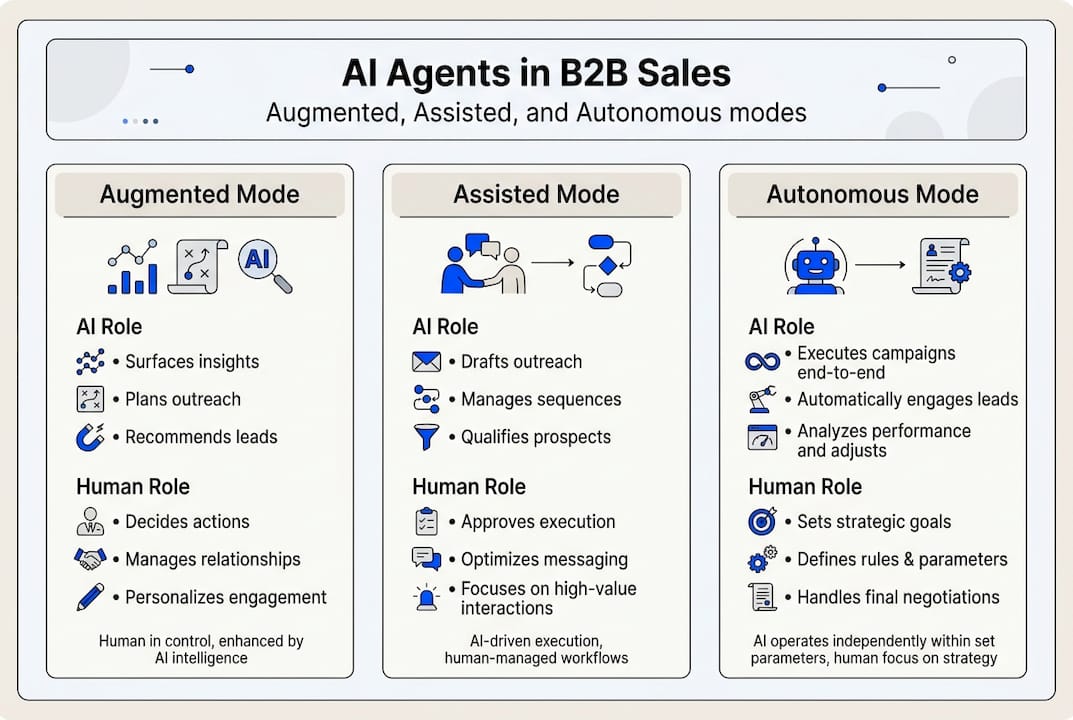
ModeAI roleHuman roleBest forAugmentedSurfaces insightsDecides and actsStrategic accountsAssistedDrafts and recommendsReviews and approvesMid-market outreachAutonomousExecutes end-to-endMonitors and governsHigh-volume prospecting
In augmented selling, AI acts like a highly informed research assistant. It surfaces account intelligence, flags intent signals, and prepares briefings. The rep still drives every decision. In assisted selling, AI goes further by drafting outreach, suggesting next steps, and recommending which contacts to prioritize. In autonomous selling, AI handles entire prospecting sequences, from identifying targets to sending personalized outreach, with humans monitoring outcomes rather than executing tasks.
The productivity gains are significant. Automating prospecting at the assisted or autonomous level can free up several hours per rep per week, time that goes directly back into high-value selling conversations.
One insight worth noting: organizations that use AI for new customer acquisition and upselling report up to 40% higher lifetime value from those accounts compared to purely manual approaches. The reason is precision. AI identifies the right moment, the right message, and the right contact, which makes every touchpoint more relevant.
The AI prospect finder capability within purpose-built platforms takes this further by matching your service portfolio against account profiles automatically, surfacing cross-sell and upsell angles that reps would otherwise miss. For organizations managing dozens of service lines, that kind of portfolio-aware intelligence is a genuine differentiator.
Sales leaders should think carefully about which mode fits which segment. Strategic accounts with complex stakeholder maps still benefit from augmented AI, where human judgment shapes the engagement strategy. High-volume prospecting into new markets is where autonomous agents deliver the clearest ROI. As noted in Gartner’s AI in sales overview, organizations that match AI mode to sales motion see faster adoption and stronger results.
Data readiness and workflow integration for maximum ROI
AI prospecting tools are only as good as the data they run on. That sounds obvious, but it is where most implementations stall. Organizations invest in AI platforms and then discover their CRM data is incomplete, their account records are outdated, and their segmentation logic is inconsistent. The result is AI that confidently produces the wrong answers.
G2’s research on AI sales intelligence is direct on this point: AI excels in scaling personalization and signal synthesis, but it needs human oversight for nuanced B2B interactions, and organizations must prioritize data readiness and workflow integration to achieve real ROI.
Here is a practical sequence for getting your sales organization AI-ready:
- Audit your CRM data quality. Identify gaps in contact records, outdated account information, and missing firmographic fields. Clean data is the foundation everything else depends on.
- Define your ideal customer profile clearly. AI needs precise parameters to score and segment effectively. Vague ICP definitions produce vague lead lists.
- Map your existing workflows before automating them. Understand how reps currently prospect, qualify, and hand off leads. Automating a broken process just produces broken results faster.
- Integrate AI tools with your CRM and document management systems. Siloed tools create friction. Seamless integration means AI insights flow directly into the systems reps already use.
- Start with high-priority target segments. Rather than rolling out AI prospecting across your entire addressable market at once, focus on the accounts where the ROI case is strongest. Build confidence and refine the model before scaling.
- Establish feedback loops. Track which AI-generated leads convert and which do not. Feed that data back into your scoring models to improve accuracy over time.
For sales leaders looking to optimize sales enablement workflow across complex organizations, the integration step is often the most underestimated. Connecting AI to your AI account management processes ensures that prospecting intelligence carries through the full sales cycle, not just the top of the funnel.
Pro Tip: Start your AI prospecting rollout with your top 20% of target accounts. The data is usually cleaner, the stakes are higher, and the wins are visible enough to build internal momentum for broader adoption.
As Forrester’s analysis of AI sales strategy notes, competitive advantage from AI erodes quickly when everyone adopts the same tools. The differentiator becomes how well you integrate AI into your specific workflows and how effectively your team acts on the intelligence it generates.
Challenges, limitations, and human oversight in AI prospecting
AI prospecting tools are genuinely powerful. They are also genuinely limited in ways that matter for complex B2B sales. Understanding those limits is not pessimism. It is how you avoid expensive mistakes.
The most common challenges sales organizations encounter include:
- Data quality gaps: AI models trained on incomplete or inaccurate CRM data will produce unreliable lead scores and misaligned outreach.
- Integration complexity: Connecting AI tools to legacy CRM systems, document management platforms, and existing workflows takes more time and technical effort than vendors typically advertise.
- Over-reliance on automation: Teams that hand off too much to AI without reviewing outputs lose the contextual judgment that makes complex B2B outreach effective.
- Governance gaps: Without clear ownership of data quality and AI output review, errors compound over time and erode trust in the system.
- Personalization that feels generic: AI-generated outreach can read as templated if the underlying account data is thin or the prompts are not well-configured.
Forrester’s research on AI in sales makes a critical point: data quality limits accuracy, governance is non-negotiable, and AI is not a full replacement for humans in complex deals. That last point deserves emphasis. In enterprise B2B sales, where relationships, trust, and nuanced negotiation determine outcomes, AI handles the preparation and the pattern recognition. Humans still close the deal.
The governance question is particularly important for organizations in regulated industries like defense, telecommunications, or logistics. Knowing which data feeds your AI, who reviews its outputs, and how errors get corrected is not optional. It is a prerequisite for responsible deployment.
“AI becomes table stakes without strong operating models. The organizations that pull ahead are those that combine AI capability with disciplined governance and human expertise.”
For sales leaders thinking about human judgment for AI integration, the practical question is not whether to use AI but how to structure the human review layer. Qualifying B2B leads effectively still requires a human to assess relationship dynamics, political context within an account, and strategic fit in ways that AI simply cannot replicate today. McKinsey’s findings on AI’s limitations reinforce that the highest-performing organizations treat AI as a force multiplier for their best people, not a substitute for them.
What most leaders miss: Human judgment amplifies AI success
Here is the perspective most AI vendor conversations skip: the organizations seeing the strongest results from AI prospecting are not the ones with the most sophisticated tools. They are the ones with the clearest human review processes.
There is a tendency in sales leadership to treat AI adoption as a binary choice. Either you automate prospecting or you do not. That framing misses the point entirely. AI excels in scaling personalization and signal synthesis, but nuanced B2B interactions still require human oversight to be truly effective. The real competitive advantage comes from the combination.
Think of it this way. AI can identify that a target account has recently expanded its IT budget, hired three new procurement leads, and is consuming content about supply chain optimization. That is remarkable signal synthesis. But a seasoned sales rep knows that the new procurement lead used to work at one of your existing clients and has a specific preference for how vendors engage. That contextual layer is what converts a warm signal into a won deal.
The leaders who get the most from AI are those who treat it as an enabler of their team’s expertise, not a replacement for it. They build weekly review cadences where reps assess AI-generated recommendations, flag anomalies, and feed corrections back into the system. Over time, the AI gets sharper. The team gets faster. And the results compound. For practical guidance on integrating human oversight into your AI workflows, the key is structure, not volume. A short, focused weekly review beats an occasional deep audit every time.
Enhance prospecting with Uman’s AI-powered solutions
The insights in this guide point to a clear conclusion: AI prospecting works best when it is purpose-built for complex B2B sales environments and tightly integrated with your existing workflows.
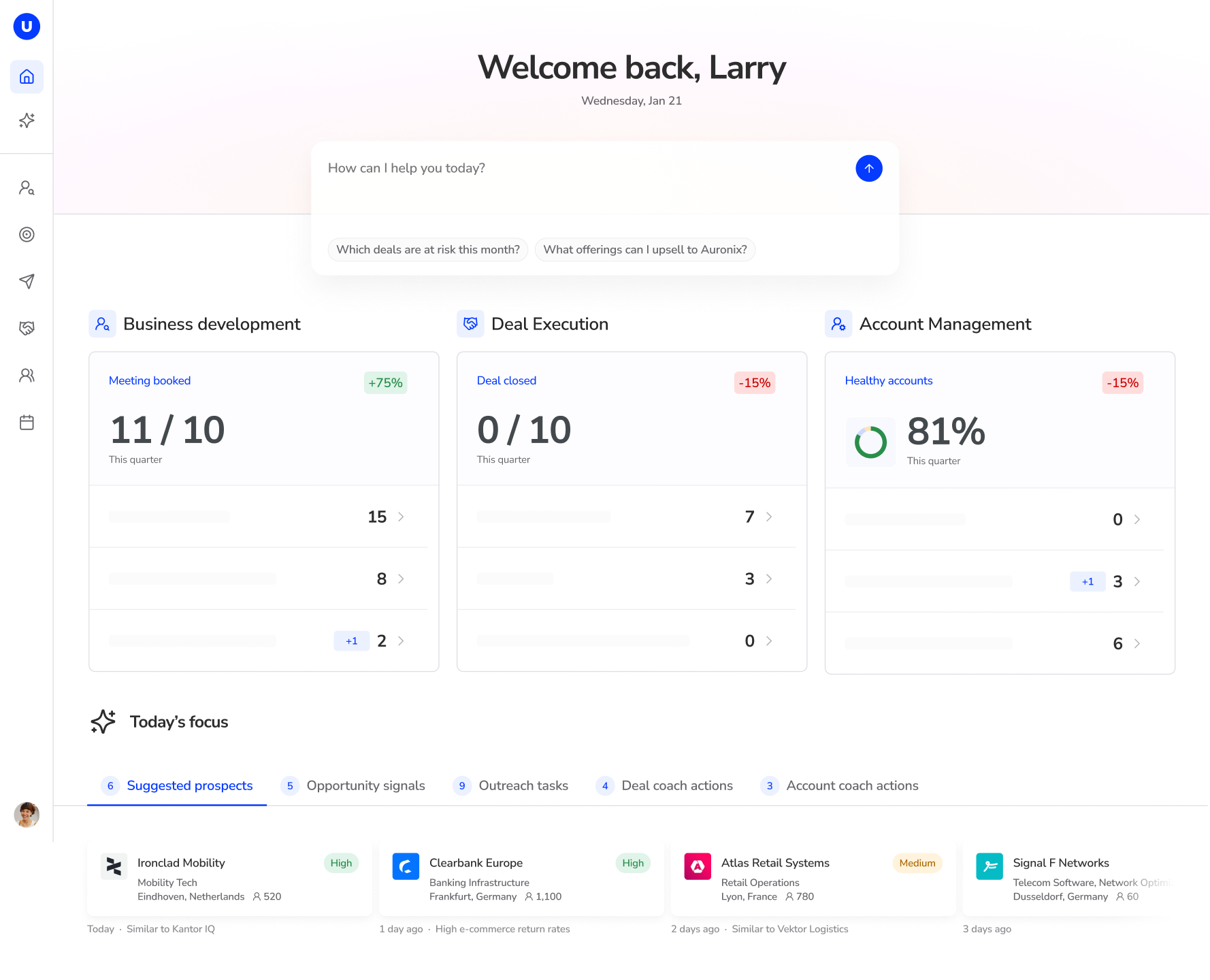
Uman’s platform is designed exactly for that context. It centralizes your sales knowledge, automates prospecting and outreach, and surfaces cross-sell and upsell opportunities your team would otherwise miss. The deal execution tools support every stage from qualification to close, while account management solutions ensure your existing accounts receive the same intelligence-driven attention as new prospects. If you are ready to move from manual prospecting to a governed, AI-powered approach, Uman gives your team the structure to do it confidently.
Frequently asked questions
What are the key benefits of using AI in B2B prospecting?
AI increases conversion rates by up to 25%, cuts prospecting research time in half, and enables significantly more accurate lead targeting through predictive scoring and intent data analysis.
Can AI agents fully replace human sales reps in prospecting?
No. While AI handles research, scoring, and outreach at scale, complex B2B deals still require human judgment for relationship nuance, stakeholder dynamics, and strategic positioning.
How can sales teams ensure maximum ROI from AI prospecting tools?
Start with clean, structured data, integrate AI directly with your CRM, and focus initial rollout on high-priority accounts where data quality is strongest and the ROI case is clearest.
What are the biggest challenges or risks with AI in prospecting?
Data quality and governance gaps are the most common risks. Without accurate underlying data and clear review processes, AI outputs can mislead rather than guide your prospecting efforts.
How widely is AI adopted for B2B prospecting in 2026?
As of 2026, 60% of B2B sales teams actively use AI tools for prospecting and qualification, though effective adoption varies significantly based on data readiness and workflow integration depth.
Recommended
Prep like a machine, sell like a human
Let AI handle the research and prep work — you focus on building relationships and closing deals.