%20(1).png)
AI strategies to transform B2B sales in 2026
Discover how AI is reshaping B2B sales in 2026, with benchmarks, risk frameworks, and practical strategies for sales executives managing complex pipelines.
TL;DR:
- AI and automation are transforming B2B sales by automating tasks and creating new roles for reps.
- Buyer behavior is shifting toward self-directed, AI-supported purchasing, reducing the role of human reps.
- Effective AI use requires governance, training, and balancing automation with human judgment to maximize sales success.
Most sales leaders still think of B2B selling as fundamentally relationship-driven. That instinct is not wrong, but it is increasingly incomplete. 67% of B2B buyers now prefer rep-free purchases, often powered by AI tools that handle discovery, evaluation, and even negotiation without a human seller in the room. That shift is not a distant trend. It is reshaping pipelines, quotas, and team structures right now. This article walks through what AI and automation are doing to B2B sales teams, how the buyer journey has changed, what risks you need to manage, and which frameworks will actually move the needle for your organization in 2026.
Table of Contents
- How AI and automation are reshaping B2B sales teams
- From rep-led to rep-free: The new B2B buying journey
- Key pitfalls: Risks in AI-enabled sales and how to avoid them
- Winning strategies: Metrics, frameworks, and practical steps for 2026
- Why hybrid human-AI sales models outpace pure automation
- AI-driven sales: Turn strategy into action with Uman
- Frequently asked questions
Key Takeaways
PointDetailsAI powers sales efficiencyAI-driven tools now underpin lead qualification and buyer engagement, making B2B sales faster and more data-driven.Rep-free buying riseMost buyers prefer AI-enabled, rep-free journeys, and sales teams must deliver value beyond automation.Governance prevents AI risksOngoing oversight and skills training are essential to avoid costly errors and trust issues with AI-generated sales content.Hybrid wins over pure automationBlending AI automation with human creativity and relationship skills is the most effective sales approach in 2026.
How AI and automation are reshaping B2B sales teams
AI and automation are not just adding speed to existing processes. They are changing which tasks humans do at all. Lead qualification that once took hours of manual research now happens in minutes through predictive scoring. Personalized outreach that required a skilled rep to craft from scratch is now generated, reviewed, and sent at scale. Forecasting that relied on gut feel is now grounded in pattern recognition across thousands of data points.
The scale of this shift is striking. Two-thirds of sales-enabling content will be created by employees outside content teams using generative AI by the end of 2026. That means your sales reps are becoming content creators, whether you planned for it or not. The enablement function has to evolve to govern that output, not just produce it.
Here is a snapshot of how AI is changing core sales activities:
Sales activityBefore AIWith AILead qualificationManual research, 2-4 hours per leadAutomated scoring, minutes per leadMeeting preparationRep-driven, inconsistentStructured briefs generated on demandCRM updatesManual entry after callsAuto-populated from conversation dataContent generationCentralized team, slow turnaroundRep-level, real-time, governed by platformCross-sell identificationRelationship memory, ad hocAI-driven portfolio matching
The productivity gains are real. But so are the risks. Ungoverned generative AI in commercial applications is projected to cost B2B companies over $10 billion in 2026. That cost comes from inaccurate information reaching buyers, compliance failures, and skills gaps that leave teams unable to catch AI errors before they cause damage.
The key principles for sales leaders navigating this:
- Redefine roles so reps focus on judgment, relationships, and complex problem-solving
- Build governance into every AI-powered workflow, not as an afterthought
- Invest in training that helps reps evaluate and improve AI output, not just accept it
Pro Tip: Think of AI as a highly capable but junior team member. It needs clear briefs, regular review, and guardrails. Collaborating with AI tools effectively is a skill your team needs to develop deliberately, not assume will happen naturally.
For a deeper look at how AI is boosting efficiency across the sales cycle, AI sales efficiency tips offer practical guidance grounded in real B2B contexts.
From rep-led to rep-free: The new B2B buying journey
With AI transforming the B2B sales organization, let’s trace how these changes play out in the buyer journey itself.
The modern B2B buyer does not wait for a rep to guide them through discovery. They research independently, compare options using AI-powered tools, and often arrive at a shortlist before any human seller is involved. This is not a niche behavior. 67% of B2B buyers prefer rep-free purchasing, and AI already supports 45% of recent purchases.

The negotiation stage is shifting too. 20% of B2B sellers now find themselves negotiating with AI-powered buyer agents rather than human procurement contacts. That is not science fiction. It is a live challenge for enterprise sales teams today.
StageClassic rep-led modelRep-free / AI-enabled modelDiscoveryRep-initiated outreachBuyer-led, AI-assisted researchEvaluationDemo-driven, rep-guidedSelf-serve content, AI comparison toolsNegotiationHuman rep and buyerAI buyer agent and seller systemDecisionRelationship-influencedData-driven, often automated
“The buyer journey has become a self-directed experience. Reps who add value only at the pitch stage are arriving too late.”
So where do human reps still win? In complex, high-stakes deals where trust, nuance, and creative problem-solving matter. A rep who understands a client’s strategic priorities and can connect them to the right solution across a broad portfolio is genuinely hard to replace. That is where your best people should spend their time.
Here is how to adapt your approach:
- Map your buyer journey to identify where AI-enabled self-service is already happening
- Create content and tools that support buyers during the rep-free stages
- Train reps to enter the conversation at the right moment, with context already loaded
- Use AI prospecting strategies to identify high-intent signals earlier
- Automate routine follow-up so reps can focus on high-value interactions
Pro Tip: Do not fight the rep-free trend. Instead, design your sales motion so that AI handles the early stages well, and your reps show up at exactly the right moment with exactly the right insight. Automated prospecting methods can help you build that handoff point deliberately.
Key pitfalls: Risks in AI-enabled sales and how to avoid them
As buyer journeys and sales processes go digital and AI-driven, the need to manage new risks grows more urgent.
The financial stakes are clear. Ungoverned generative AI will cost B2B companies over $10 billion in 2026 through inaccurate information, compliance failures, and skills gaps. Most of that cost is avoidable with the right governance structure in place.
The most common risk areas break down into three categories:
- Accuracy and compliance: AI hallucinations (meaning AI generating plausible but factually wrong information) can reach buyers in proposals, emails, and presentations if no human reviews the output. In regulated industries, this creates real legal exposure.
- Buyer trust: Buyers who discover they received AI-generated content that was inaccurate or felt impersonal will disengage. Transparency about AI use is becoming a competitive differentiator, not a liability.
- Skill gaps: Many sales teams are adopting AI tools faster than they are developing the skills to evaluate AI output critically. This creates a false sense of confidence.
“The risk is not that AI will replace your sales team. The risk is that your sales team will trust AI output without the skills to catch its mistakes.”
Actionable steps to reduce these risks:
- Implement a clear AI governance policy that defines what AI can generate and what requires human review
- Build validation checkpoints into every AI-assisted workflow, especially for client-facing content
- Run regular training sessions focused on evaluating and improving AI output, not just using AI tools
- Disclose AI use to buyers where appropriate, framing it as a commitment to speed and accuracy
For a candid look at where AI-enabled sales processes commonly break down, AI sales process challenges is worth reading before you scale your AI stack. Additional AI trust and risk insights from Forrester provide useful context for building your governance framework.
Pro Tip: Treat every AI-generated client-facing output as a draft, not a final product. One human review step before sending can prevent the kind of trust-breaking errors that cost deals.
Winning strategies: Metrics, frameworks, and practical steps for 2026
Understanding the risks, sales executives now need a precise roadmap for driving efficiency and revenue with AI.
The highest-impact methodologies for complex B2B sales in 2026 share a common thread: they combine AI-driven data with human judgment at the moments that matter most.
- Multi-threading: Engage multiple stakeholders simultaneously using AI to track relationship maps and surface gaps
- AI lead scoring: Prioritize outreach based on behavioral signals, firmographic fit, and engagement history
- Value-based selling: Use AI to match your portfolio to client-specific business outcomes, not just product features
- Signal-led prioritization: Let AI surface which accounts are showing buying intent right now, so reps focus energy where it converts
Top-performing sales organizations in 2026 are running sales cycles of 43 to 52 days, achieving win rates of 36 to 42%, and hitting quota attainment of 84 to 91%. These are the benchmarks worth measuring against.

MetricAverage performanceTop-performer benchmarkSales cycle length60-90 days43-52 daysWin rate20-28%36-42%Quota attainment60-70%84-91%
Here is a step-by-step approach to embedding AI in your sales operations:
- Audit your current sales process to identify where time is lost to manual tasks
- Prioritize AI tools that integrate with your existing CRM and content systems
- Start with one workflow, such as meeting preparation or CRM updates, and prove the value
- Build governance and review steps into the workflow from day one
- Measure impact against the benchmarks above and expand from there
One often-overlooked lever: external expertise. 75% of enterprise B2B companies plan to increase influencer budgets as buyers increasingly rely on trusted external voices during AI-assisted discovery. Building relationships with credible industry voices is now part of the sales motion, not just marketing.
For teams working on optimizing sales cycles, the combination of AI-driven prioritization and structured workflows is where the biggest gains are being found.
Why hybrid human-AI sales models outpace pure automation
Conventional wisdom says the goal is to automate as much of the sales process as possible. Replace reps with AI wherever you can, reduce headcount, and watch margins improve. That logic is appealing on a spreadsheet. It does not hold up in the field.
The most effective B2B sales organizations are not pursuing full automation. They are building what Forrester describes as agentish, not purely agentic go-to-market designs, where AI handles the workflow and humans focus on nuance, relationships, and strategy. The distinction matters enormously in complex deals where trust is the deciding factor.
We have seen this pattern clearly: AI wins on speed and scale, but humans win on judgment and connection. The organizations pulling ahead are the ones who have stopped treating these as competing priorities. They use human-AI collaboration as a design principle, not an afterthought. The question is not how much AI can replace, but how much AI can amplify the people you already have.
AI-driven sales: Turn strategy into action with Uman
The strategies in this article are only as valuable as your ability to execute them consistently across your entire sales team. That is where having the right platform makes all the difference.
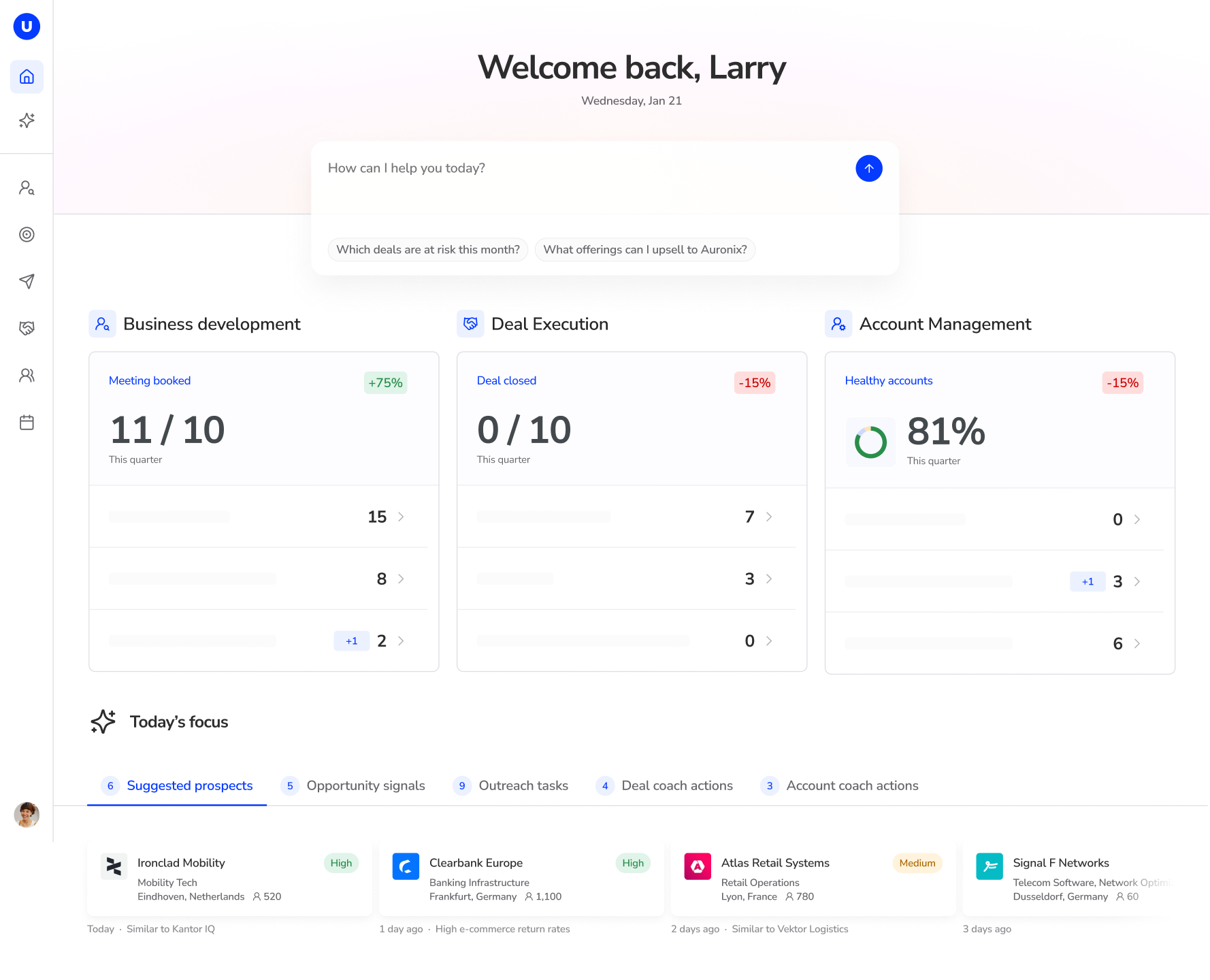
Uman is built specifically for complex B2B sales organizations managing broad portfolios. It centralizes your sales knowledge into a governed data layer, then powers structured workflows across business development, deal execution, and AI account management. Your reps get accurate, on-brand content on demand, without needing advanced prompting skills or hours of manual preparation. Explore the Uman platform to see how leading B2B sales teams are turning AI strategy into measurable revenue growth.
Frequently asked questions
How are B2B sales cycles changing with AI in 2026?
Sales cycles are shortening as AI accelerates lead qualification, customer engagement, and negotiation steps. Top-performing organizations are now running cycles as short as 43 to 52 days.
What are the top risks of using AI in B2B sales?
The biggest risks are AI-generated inaccuracies and skill gaps, which can cost companies billions without strong governance. Ungoverned generative AI is projected to cost B2B companies over $10 billion in 2026.
Will AI replace human sales reps by 2026?
Not fully. AI handles many tasks efficiently, but human reps remain essential for building trust, managing complex deals, and creative problem-solving. Hybrid models outperform purely agentic approaches for revenue control.
How can sales teams reduce AI-related risks?
Implement governance policies, provide regular training, and always have humans validate critical AI outputs before they reach buyers. Ongoing skills training and structured oversight are the most effective safeguards available today.
Recommended
Prep like a machine, sell like a human
Let AI handle the research and prep work — you focus on building relationships and closing deals.