%20(1).png)
AI in B2B sales: The essential role for success in 2026
Discover how AI transforms B2B sales with predictive, generative, and agentic tools. Learn frameworks to build lasting competitive advantage in 2026.
TL;DR:
- AI will dominate 95% of seller research by 2027, but strategic integration is essential for competitive advantage.
- Effective AI use in sales depends on data quality, clear processes, and maintaining human oversight.
- Success requires building a hybrid AI-human operating model, starting with high-ROI use cases and continuous iteration.
By 2027, 95% of seller research will start with AI. That statistic alone should stop any sales leader in their tracks. Yet across complex B2B organizations, a troubling gap persists: teams are adopting AI tools at record speed, but most are struggling to convert that adoption into a genuine, lasting competitive edge. The difference between using AI and winning with AI is not about which platform you buy. It is about how clearly you understand what AI can and cannot do, and how deliberately you build it into your sales process, your data, and your people.
Table of Contents
- Why AI matters in B2B sales today
- The essential roles of AI: Predictive, generative, and agentic
- Pitfalls and misconceptions: Data quality, agentic hype, and the human factor
- Framework for AI-powered sales excellence
- An on-the-ground view: What most B2B leaders miss about AI in sales
- Empower your sales organization with next-gen AI solutions
- Frequently asked questions
Key Takeaways
PointDetailsAI is table stakesWidespread AI adoption means leaders must seek advantage in processes, not just technology.Predictive and generative valueLead scoring, personalization, and content generation offer the fastest ROI for B2B sales teams.Data quality mattersClean, consistent CRM data is critical to getting accurate and actionable AI insights.Hybrid models winPairing AI with human oversight and validation ensures trust, flexibility, and sales impact.Framework over toolsA strategic operating model integrating AI with process and incentives sustains competitive advantage.
Why AI matters in B2B sales today
The B2B sales landscape has shifted faster in the past two years than in the previous decade. Buyers are better informed, sales cycles are longer, and the volume of data that reps must process before a single call has multiplied. AI has emerged as the most credible answer to these pressures, but the reality is more nuanced than most vendor pitches suggest.
Here is the core tension every sales leader faces: because AI tools are now widely accessible, the tools themselves are quickly becoming table stakes rather than differentiators. When every competitor uses the same lead scoring engine or the same email drafting assistant, the tool alone cannot give you an edge. What separates high-performing organizations is how they apply AI within a disciplined operating model.
The stakes for getting this wrong are real:
- Missed quota: Reps buried in manual research and CRM updates have less time for actual selling.
- Slower deal cycles: Without AI-assisted preparation and follow-up, deals stall at critical stages.
- Weaker engagement: Generic outreach, the kind that happens when AI is used carelessly, erodes buyer trust.
- Lost talent: Top performers leave organizations where tools create friction instead of removing it.
“AI in sales often becomes table stakes quickly due to rapid tool spread, data commoditization, and buyer adaptation.” This observation from Forrester captures exactly why tool selection alone is not a strategy.
The organizations winning with AI-driven sales strategies treat AI as an amplifier of human judgment, not a replacement for it. They invest in the operating conditions that make AI outputs reliable: clean data, clear use cases, and trained people who know when to trust the machine and when to override it.
The bottom line is simple. AI in B2B sales is no longer optional. But adopting it without a clear framework is almost as risky as ignoring it entirely.
The essential roles of AI: Predictive, generative, and agentic
With the strategic importance of AI established, let us dissect the specific roles AI can perform within modern sales organizations. There are three primary categories, and understanding how each one works in practice is the foundation of any intelligent deployment.

Predictive AI analyzes historical data to forecast future outcomes. In sales, this means lead scoring, pipeline forecasting, and next-best-action suggestions. Think of it as a pattern-recognition engine: it processes thousands of past deals to tell your reps which prospects are most likely to convert and when to act.
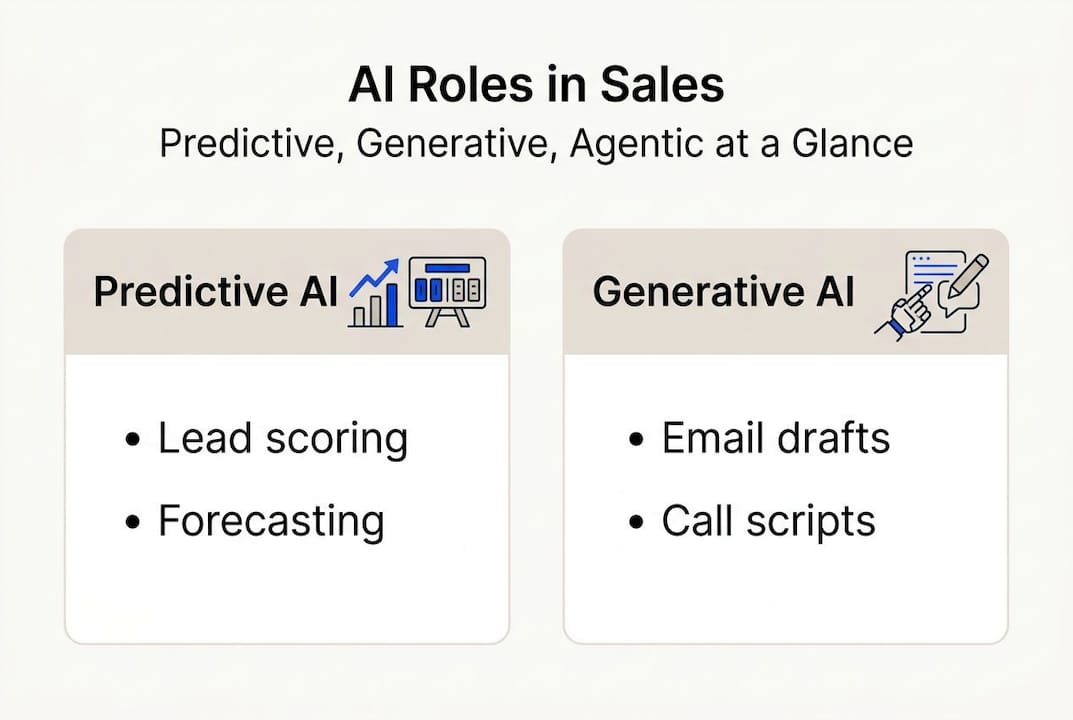
Generative AI creates new content based on prompts and context. For sales teams, this includes drafting personalized emails, building proposals, summarizing meeting notes, and generating tailored battle cards. It is the category that has attracted the most attention, and the most hype.
Agentic AI goes further by executing tasks autonomously. It can monitor CRM activity, trigger follow-up sequences, flag at-risk accounts, and route leads without waiting for human instruction. It is also the category that requires the most caution.
As Gartner recommends, the strongest results come from combining all three: predictive AI for lead qualification, generative AI for content, and agentic AI for task automation. Here is how they map to a typical deal cycle:
- Prospecting: Predictive AI scores and prioritizes accounts; generative AI drafts personalized outreach.
- Discovery: Generative AI summarizes research; predictive AI surfaces relevant talking points.
- Proposal: Generative AI builds first drafts; humans refine and approve.
- Negotiation: Agentic AI tracks stakeholder activity and flags changes in engagement.
- Close and handoff: Agentic AI updates CRM records; generative AI creates onboarding summaries.
AI typePrimary useHuman rolePredictiveScoring, forecastingValidate and actGenerativeContent, summariesReview and refineAgenticTask automationOversee and correct
Understanding AI’s impact on sales efficiency starts with knowing which type of AI belongs at which stage of your process.
Pro Tip: If you are just starting out, focus on predictive and generative AI first. They deliver faster, more measurable results and carry lower risk than agentic deployments.
Pitfalls and misconceptions: Data quality, agentic hype, and the human factor
Understanding AI’s capabilities is vital, but missteps are common. It is just as important to know where AI can fall short and how to safeguard your results.
The single biggest obstacle is data quality. 89% of sales leaders report that AI outputs are inaccurate, and in most cases, the root cause is dirty or inconsistent CRM data. AI does not fix bad data. It amplifies it. If your CRM is full of duplicate records, missing fields, and outdated contacts, every AI-generated insight will carry that contamination forward.
Common data-related pitfalls include:
- Incomplete contact and account records that skew lead scores.
- Inconsistent deal stage definitions that confuse forecasting models.
- Outdated product and pricing information that surfaces in AI-generated proposals.
- Missing interaction history that weakens personalization quality.
The second major misconception is around agentic AI. The idea of a fully autonomous sales agent is compelling, but the reality is far more limited. Gartner predicts that 40% of agentic AI projects will be canceled by 2027 because organizations underestimate the complexity of real-world sales environments. Multi-threaded B2B deals, where you are managing relationships with five or ten stakeholders simultaneously, require the kind of contextual judgment and relationship sensitivity that no current AI system can reliably provide.
Improving CRM efficiency before deploying AI is not optional. It is a prerequisite. Similarly, selecting the right AI for prospecting requires understanding which tasks genuinely benefit from automation and which demand human presence.
Pro Tip: Before selecting any AI tool, audit your CRM data quality. Assign a data steward, establish field completion standards, and run a cleanup sprint. The ROI on that investment will exceed the ROI on almost any AI tool you could purchase.
The human factor is not a limitation to work around. It is a feature to design for. The organizations that treat AI as a co-pilot rather than an autopilot consistently outperform those that try to remove human judgment from the loop entirely. Understanding AI adoption challenges upfront prevents costly course corrections later.
Framework for AI-powered sales excellence
Having explored the obstacles, let us shift into how to deploy AI strategically for lasting sales gains.
The most important insight from leading research is that sustainable advantage comes from operating models that integrate AI with processes and incentives, not from the AI tools themselves. And as practitioners consistently confirm, architecture first is the only sequence that works. You build the foundation, then you add the technology.
Here is a practical sequence for deploying AI in a complex B2B sales environment:
- Map your sales process: Document every stage, every task, and every decision point. Identify where time is wasted and where information is missing.
- Audit your data: Assess CRM completeness, accuracy, and consistency. Fix the most critical gaps before any AI deployment begins.
- Select high-ROI use cases: Start with research automation, meeting preparation summaries, and CRM update assistance. These deliver visible time savings quickly.
- Choose tools that fit your architecture: Select AI solutions that integrate with your existing CRM and content systems rather than adding complexity.
- Measure and iterate: Define clear KPIs before launch. Track time saved, pipeline velocity, win rates, and rep adoption. Adjust based on what the data tells you.
Key principles for a hybrid AI-human workflow that actually holds up:
- Use AI for repetitive, data-intensive tasks: research, summarization, data entry.
- Keep humans in control of relationship-sensitive decisions: negotiation strategy, stakeholder mapping, executive engagement.
- Build feedback loops so reps can flag inaccurate AI outputs and improve the system over time.
- Align incentives so that reps are rewarded for smart AI use, not penalized for the time it takes to learn.
The Gartner AI in sales framework reinforces this point clearly. Organizations that treat AI as a process transformation tool, rather than a productivity shortcut, generate compounding returns. Those that skip the operating model work and jump straight to tool deployment rarely sustain their early gains.
Pro Tip: Your operating model is your real competitive advantage. Two organizations using the same AI tool will get very different results based on how well their data, processes, and people are aligned around it. Invest there first. You can always upgrade the tool later. For deeper thinking on AI sales process insights, this is worth exploring before you commit to any deployment plan.
An on-the-ground view: What most B2B leaders miss about AI in sales
Here is a reality check that most AI vendors will not give you. The organizations that struggle most with AI in sales are not the ones that chose the wrong tool. They are the ones that chose the right tool and then ignored everything else.
We see this pattern repeatedly. A sales leader invests in a promising AI platform, runs a successful pilot, and then watches adoption collapse within six months. The reason is almost never the technology. It is culture, process, and incentives. Reps revert to old habits when AI outputs are unreliable. Managers stop trusting forecasts when the underlying data is messy. The tool becomes shelfware.
As Gartner’s research confirms, an operating model that genuinely integrates AI with how people work and how they are measured will consistently outperform a superior AI model deployed into a broken process. That is a counterintuitive finding for leaders who are used to solving problems by buying better technology.
The honest advice is this: run small pilots, build feedback loops, and treat every AI deployment as a learning exercise rather than a finished solution. The organizations generating real revenue lift from AI are the ones that stay curious, stay humble, and keep humans meaningfully involved. AI is not a fix-all, and accepting that reality is the first step toward using it well.
Empower your sales organization with next-gen AI solutions
If you are ready to move from theory into practice, the next step is finding technology built specifically for the complexity of B2B sales. Generic AI tools can help at the margins, but purpose-built platforms deliver the governed data layer, structured workflows, and CRM integration that complex sales organizations actually need.
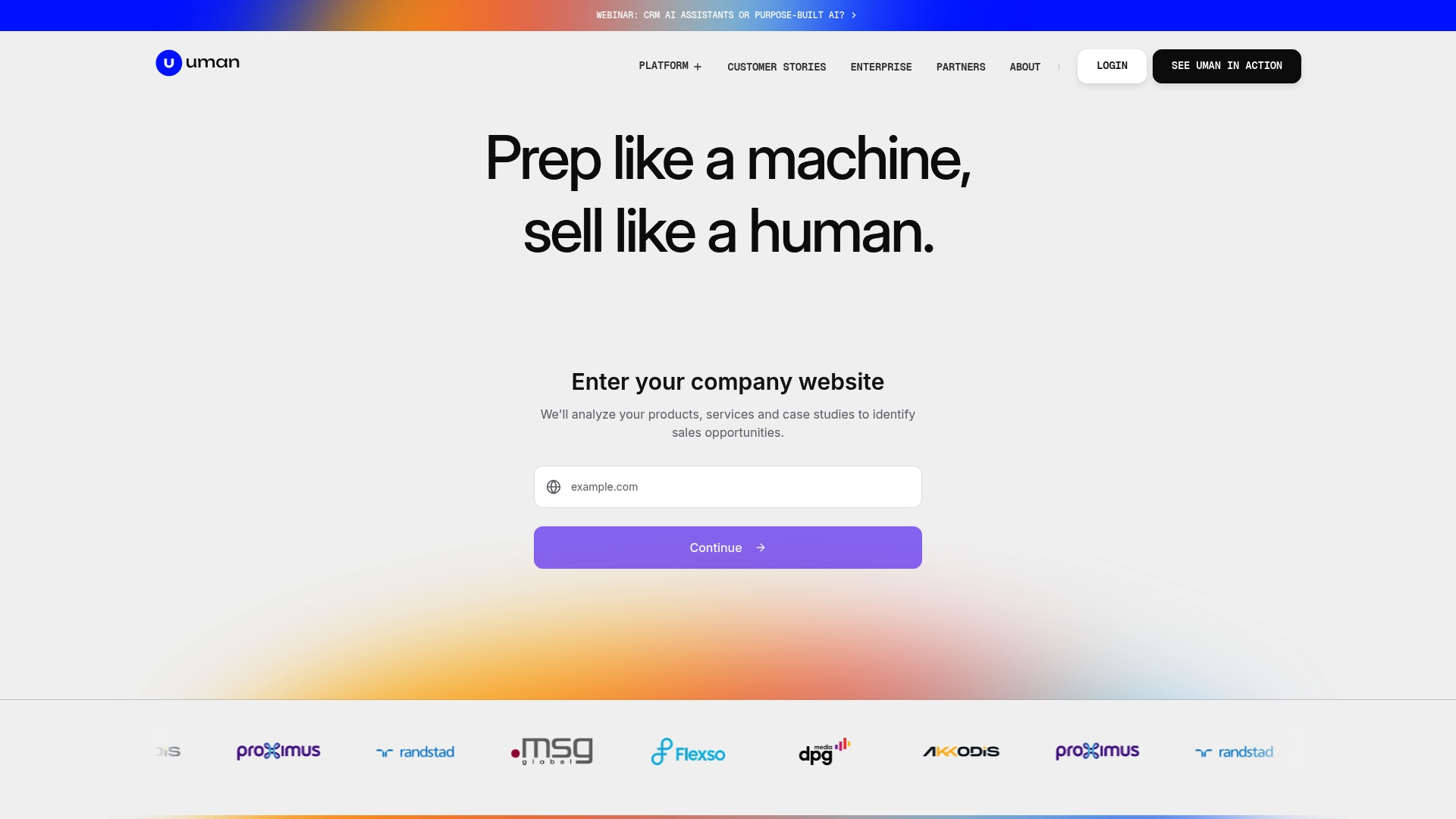
Uman’s AI sales platform is designed to support exactly the kind of human-AI hybrid model this article describes. From automated deal preparation to intelligent AI account management tools that surface cross-sell and upsell opportunities, uman helps sales teams work faster without sacrificing the judgment that closes complex deals. Explore the platform or reach out to discuss a tailored strategy for your organization.
Frequently asked questions
What is the most impactful use of AI in B2B sales?
Predictive lead scoring and AI-powered personalization deliver the quickest and largest ROI in B2B sales environments. Combining all three AI types, predictive, generative, and agentic, across the deal cycle produces the strongest cumulative results.
How do you avoid inaccurate AI-based sales insights?
Focus on cleaning and standardizing CRM data before deploying any AI tool, and always validate AI-driven recommendations with human judgment. 89% of leaders who report inaccurate AI outputs trace the problem back to poor data quality, not the AI itself.
Can autonomous AI replace salespeople in complex B2B deals?
No. Agentic AI automates routine work effectively, but relationship-building and deal navigation in complex, multi-stakeholder environments still require experienced sales professionals. 40% of agentic AI projects are predicted to be canceled by 2027 due to this underestimated complexity.
How should sales leaders prioritize AI initiatives?
Begin with high-value use cases like research automation and meeting preparation, and ensure data hygiene is addressed before scaling. Starting with high-ROI use cases reduces risk and builds the internal confidence needed for broader AI adoption.
Recommended

Prep like a machine, sell like a human
Let AI handle the research and prep work — you focus on building relationships and closing deals.