%20(1).png)
GDPR in B2B sales: a practical guide for compliance leaders
Learn how GDPR applies to B2B sales outreach, legitimate interest assessments, and practical compliance methodologies for sales leaders and compliance officers.
TL;DR:
- GDPR permits B2B cold outreach when relying on legitimate interest and proper documentation.
- Conducting and recording a Legitimate Interest Assessment ensures lawful and compliant sales practices.
- Most compliance issues stem from poor opt-out handling, data minimization, and country-specific regulations.
GDPR has a reputation for paralyzing sales teams. Many leaders assume that cold outreach is blocked under GDPR, when in reality the regulation requires thoughtful adaptation, not a full stop. The real challenge is knowing which rules apply, how to document your reasoning, and how to scale compliant practices across a large sales organization. This guide walks sales leaders and compliance officers through lawful bases, Legitimate Interest Assessments, practical methodologies, and country-specific nuances so your team can prospect, qualify, and close with confidence.
Table of Contents
- Understanding lawful bases for B2B sales data processing
- How to perform and document a Legitimate Interest Assessment (LIA)
- Practical GDPR methodologies for B2B sales teams
- Special cases, country variations, and vendor compliance in B2B sales
- Our take: what most organizations miss about GDPR in B2B sales
- How Uman helps B2B teams achieve GDPR-compliant sales
- Frequently asked questions
Key Takeaways
PointDetailsLegitimate interest is keyMost B2B sales rely on legitimate interest for GDPR-compliant data processing.Document every assessmentKeep Legitimate Interest Assessments and processing records for accountability and audit readiness.Country rules can varyCheck local regulations—some EU countries enforce stricter rules for B2B sales outreach.Prioritize practical complianceEmbed GDPR methodologies like data minimization and transparent opt-out handling in your sales workflows.View GDPR as strategicCompliance isn’t just risk management—it can boost trust and enable effective sales scaling.
Understanding lawful bases for B2B sales data processing
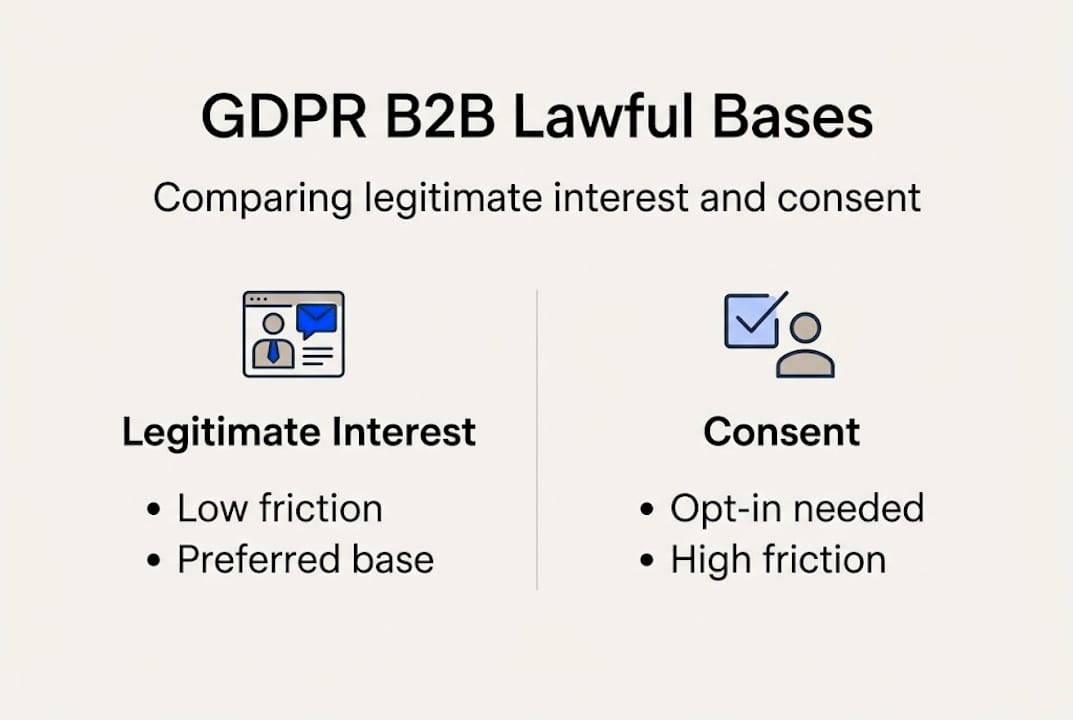
Every time your sales team processes personal data, such as a contact’s name, email, or job title, there must be a lawful basis under GDPR. The two most relevant bases for B2B sales are legitimate interest and consent under Article 6(1)(f) and Article 6(1)(a) respectively. Choosing the right one shapes everything from your outreach cadence to your data retention policy.
Consent sounds safe, but it creates friction. Requiring explicit opt-in before any outreach dramatically reduces your addressable market and makes prospecting nearly impossible at scale. Legitimate interest, by contrast, allows processing when your business need is genuine, the data use is necessary, and the individual’s rights do not override your interest. For most B2B sales activities, legitimate interest is the more practical and defensible choice.
To rely on legitimate interest, you must pass a three-part test:
- Purpose test: Is there a genuine, specific business purpose? For example, reaching out to IT directors about a relevant software solution qualifies. Blanket mass marketing to unrelated contacts does not.
- Necessity test: Is processing the data actually necessary to achieve that purpose? If you can accomplish the goal with less data or a less intrusive method, you should use it.
- Balancing test: Do the individual’s privacy interests outweigh your legitimate interest? Business contacts generally have lower privacy expectations for professional communications than consumers do.
Reviewing your B2B sales compliance guide alongside these tests helps clarify which activities qualify and which need closer scrutiny.
FactorLegitimate interestConsentFriction for sales teamLowHighRequires prior opt-inNoYesFlexibility for cold outreachHighVery lowDocumentation requiredLIA neededConsent records neededRisk if challengedMedium (if LIA is weak)Low (if consent is valid)
For most best practices for B2B sales, legitimate interest is the preferred route, provided you document it carefully and honor opt-outs promptly.
How to perform and document a Legitimate Interest Assessment (LIA)
Once you identify legitimate interest as your lawful basis, you need to evidence it. A Legitimate Interest Assessment (LIA) is the formal record that demonstrates you ran the three-part test and reached a reasoned conclusion. The ICO recommends keeping LIAs on file as part of your accountability obligations.
Here is how to structure an LIA for a typical B2B sales activity:
- Describe the purpose clearly. State exactly what you intend to do with the data. For example: “We will contact senior procurement managers at manufacturing firms to introduce our logistics software.”
- Confirm necessity. Explain why processing this data is required. Could you achieve the same goal without collecting or using this information? If not, document why.
- Run the balancing test. Assess whether the contact’s privacy interests override yours. Consider factors like the nature of the data, the relationship between your organization and the contact, and whether the individual would reasonably expect this type of outreach.
- Record the outcome. State your conclusion and the reasoning behind it. If the balance tips in your favor, you may proceed. If not, reconsider the activity or seek consent instead.
A practical LIA table for your records might look like this:
LIA componentExample entryPurposeOutreach to IT directors at mid-market firmsNecessityEmail is the only practical channel for initial contactBalancing test outcomeProfessional context; low privacy impact; outreach is relevantDecisionLegitimate interest confirmedReview dateEvery 12 months or on process change
Integrating LIA completion into your qualifying B2B leads workflow ensures that compliance is baked in from the start, not added as an afterthought. Pair this with B2B CRM best practices to track opt-outs and data subject access requests (DSARs) systematically.

Pro Tip: Train your entire sales team, not just legal, on how to recognize an opt-out and how to log it immediately in your CRM. A single missed opt-out can undermine an otherwise solid LIA. Speed and consistency here are non-negotiable.
For additional context on GDPR legitimate interest in B2B marketing, the Ethical Data Hub provides a useful breakdown of how nuance plays out across different outreach scenarios.
Practical GDPR methodologies for B2B sales teams
Documenting your LIA is the foundation, but day-to-day GDPR compliance requires operational discipline. The key methodologies that B2B sales teams need to embed include data minimization, transparency, security, opt-out handling, and records of processing.
Here is what each looks like in practice:
- Data minimization: Collect only the fields you genuinely need. If a job title and work email are sufficient for outreach, do not also collect personal phone numbers or home addresses. Lean CRM records are easier to manage and lower your compliance risk.
- Transparent privacy notices: Every prospect should be able to find out how you use their data. Include a short privacy statement in your outreach emails and link to your full privacy policy. This is not just a legal formality; it builds credibility.
- Opt-out processes: When a contact says no, stop immediately and flag the record. Your prospecting workflow optimization should include a suppression list that syncs across all tools in your stack.
- Security measures: Encrypt data in transit and at rest. Restrict CRM access to those who genuinely need it. Conduct periodic access reviews, especially when team members change roles or leave.
- Records of processing: Maintain a register of all processing activities, including the lawful basis for each. This is your audit trail if a regulator ever asks questions.
“GDPR compliance in B2B sales is not about doing less. It is about doing things right, with clear purpose and proper documentation.”
Vendor relationships also require attention. Any SaaS tool that processes prospect or customer data on your behalf needs a Data Processing Agreement (DPA) under Article 28. Review your CRM, email platform, and enrichment tools to confirm DPAs are in place.
Pro Tip: Prioritize building first-party data assets. Contacts who have engaged with your content or attended your events carry a stronger legitimate interest argument and are more likely to convert. First-party data also reduces your dependency on purchased lists, which carry their own compliance risks. Explore sales productivity tips for ideas on building these assets efficiently.
Special cases, country variations, and vendor compliance in B2B sales
GDPR sets a baseline, but member states can and do layer additional rules on top. This matters significantly for B2B sales teams operating across Europe. Some countries, notably Germany and France, impose stricter requirements for cold email outreach, and purchased contact lists in those markets require clear vendor compliance proof before use.
Key edge cases to understand:
- Country-specific cold outreach rules: Germany’s UWG (Unfair Competition Act) and France’s LCEN regulation add consent requirements for electronic marketing that go beyond baseline GDPR. If you operate in these markets, consult local legal counsel before launching cold email campaigns.
- Purchased lists: Buying a contact list does not transfer compliance responsibility. You must verify that the vendor collected data lawfully, can demonstrate consent or legitimate interest, and provides documentation. If they cannot, using that list puts you at risk.
- Employee data: Even in B2B contexts, individual employees are data subjects. Their work email addresses and professional details fall under GDPR protection. This is especially relevant when targeting named individuals rather than generic role-based addresses.
- SaaS vendor DPAs: Every tool in your sales stack that touches personal data needs an Article 28 DPA. This includes enrichment platforms, sales engagement tools, and analytics software.
ScenarioGDPR baselineCountry-specific riskCold email to business contactsLegitimate interest appliesHigher bar in Germany, FrancePurchased contact listsVendor compliance requiredStricter enforcement in some marketsEmployee personal dataAlways protectedNo exceptionsSaaS data processorsDPA requiredLocal DPA templates may differ
Legitimate interest remains flexible for targeted B2B outreach, but documentation and country-specific nuance are vital. Teams focused on prospecting win rates need to factor these variables into their territory planning. And if you are exploring AI-powered sales strategies, ensure your AI tools also meet GDPR standards for data handling and vendor agreements.
Our take: what most organizations miss about GDPR in B2B sales
Most organizations treat GDPR as a legal constraint to route around. That framing is both inaccurate and counterproductive. In our view, compliance builds trust and that trust directly improves sales performance.
When your team can articulate exactly why they are reaching out, what data they hold, and how a prospect can opt out, the conversation starts from a position of credibility. That is a competitive advantage, not a burden. Buyers in regulated industries, such as defense, finance, and healthcare, actively evaluate vendor compliance posture before signing contracts.
The organizations that scale fastest are the ones that embed GDPR thinking into their sales enablement programs. They train reps on opt-out handling, build LIA templates into their lead generation workflows, and treat cross-sell strategies as an opportunity to demonstrate responsible data use with existing clients.
Pro Tip: Add a GDPR module to your sales onboarding program. New reps who understand lawful bases and opt-out obligations from day one make fewer compliance errors and build stronger client relationships from the start.
How Uman helps B2B teams achieve GDPR-compliant sales
Building compliant sales workflows at scale is exactly where structured tooling makes the difference.
The Uman sales platform is ISO 27001:2022 certified and GDPR compliant by design, with a firm commitment to never using customer data for AI model training. Its account management solutions include structured workflows for lead qualification, opt-out tracking, and CRM updates, so your team spends less time on administration and more time selling responsibly. See how Akkodis used Uman to streamline complex sales processes while maintaining rigorous data governance standards across a large, distributed sales team.
Frequently asked questions
Does GDPR block B2B sales cold outreach?
No. GDPR allows B2B cold outreach when you rely on legitimate interest and pass the three-part test. You must honor opt-outs immediately and maintain documentation of your assessment.
What documentation is needed for GDPR-compliant B2B sales?
You should maintain Legitimate Interest Assessments, clear privacy notices, and records of processing activities for every sales workflow. These form your accountability trail if regulators or prospects ask questions.
Are purchased B2B leads allowed under GDPR?
Yes, provided vendors supply compliance proof and you verify their data handling meets GDPR standards before use. Responsibility does not transfer automatically when you buy a list.
Do GDPR rules differ between countries in B2B sales?
Yes. Countries like Germany and France impose stricter rules for cold outreach beyond the GDPR baseline, so always check local regulations before launching cross-border campaigns.
What are the top GDPR compliance practices for B2B sales teams?
Focus on data minimization, transparency, strong security controls, and prompt opt-out handling. These four practices cover the majority of compliance risk in everyday B2B sales activity.
Recommended
Prep like a machine, sell like a human
Let AI handle the research and prep work — you focus on building relationships and closing deals.