%20(1).png)
What is sales enablement? Guide for B2B leaders
Learn what sales enablement really means for complex B2B teams. Discover key elements, business impact, and best practices to drive measurable sales performance.
Many sales leaders treat sales enablement as a synonym for onboarding or content libraries. That assumption is costly. The future of sales enablement shows that organizations still operating with this narrow view consistently underperform peers who treat enablement as a strategic discipline. This guide cuts through the confusion, defines what sales enablement actually covers in complex B2B environments, and gives you a practical framework to build or sharpen your approach.
Table of Contents
- Defining sales enablement: More than training and tools
- Key elements of a sales enablement program
- Business impact: Why sales enablement matters in B2B
- Modern tools and technologies powering enablement
- Best practices for implementing sales enablement at scale
- Transform your sales enablement with Uman
- Frequently asked questions
Key Takeaways
PointDetailsHolistic approachSales enablement is an ongoing strategy that combines training, content, and technology for maximum B2B impact.Measurable valueLeaders can track enablement’s success through faster onboarding, improved win rates, and increased revenue.Technology drives scaleModern platforms and AI solutions make it possible to deliver consistent, effective enablement across large teams.Best practices matterCareful planning, executive buy-in, and clear alignment help organizations avoid common enablement pitfalls.
Defining sales enablement: More than training and tools
Sales enablement is not a one-time training event or a folder of pitch decks. It is a continuous, cross-functional discipline that aligns people, processes, content, and technology to help sales teams engage buyers more effectively at every stage of the cycle.
Sales enablement integrates processes, training, and technology to empower sales teams with the right information at the right moment. That definition matters because it shifts the conversation from “what tools do we have” to “how do we systematically improve sales performance.”
In complex B2B organizations, this distinction is critical. Your reps are navigating multi-stakeholder deals, broad service portfolios, and long sales cycles. Without structured enablement, knowledge stays siloed, messaging drifts, and new hires take months to become productive. The four core components that hold a mature program together are:
- Content management: Centralized, governed, and always current
- Training and coaching: Ongoing, role-specific, and tied to real deal scenarios
- Technology: Platforms that surface the right content and automate repetitive tasks
- Analytics: Data that connects enablement activity to revenue outcomes
“Sales enablement is not a department. It is an operating system for your revenue team. When it works, every rep performs like your best rep.”
Traditional sales training delivers a skill or a product update and then stops. Enablement never stops. It adapts as your portfolio evolves, as buyer behavior shifts, and as your team grows.
Key elements of a sales enablement program
Knowing what sales enablement is gives you direction. Knowing what to build gives you traction. Successful organizations standardize playbooks, leverage digital content, and tie enablement to measurable outcomes. Here is how to translate that into a concrete program.

Core program elements compared
ElementBasic approachHigh-performing approachOnboardingGeneric product trainingRole-specific, scenario-based rampContent managementShared drive or emailGoverned, searchable, AI-curatedTrainingAnnual workshopsContinuous, embedded in workflowAnalyticsActivity trackingRevenue impact measurementCommunicationAd hoc updatesStructured, cross-functional cadence
Steps to build your enablement program
- Audit your current state. Map what content, training, and tools already exist. Identify gaps and redundancies before adding anything new.
- Define your outcomes. Tie every enablement initiative to a measurable sales metric: win rate, ramp time, deal size, or cycle length.
- Standardize your playbooks. Document the best practices your top performers already use and make them accessible to everyone.
- Select and integrate technology. Choose platforms that connect to your CRM and document management systems so reps do not have to switch contexts.
- Measure and iterate. Review adoption and outcome data quarterly. Drop what is not moving the needle.
Pro Tip: Content overload is one of the fastest ways to kill adoption. Instead of publishing everything, curate tightly. Give reps three to five resources per deal stage, not thirty. Relevance beats volume every time.
Business impact: Why sales enablement matters in B2B
Strategic enablement is not a cost center. It is a revenue lever. Companies with mature enablement achieve higher win rates and shorter sales cycles, two metrics that directly affect your top line.
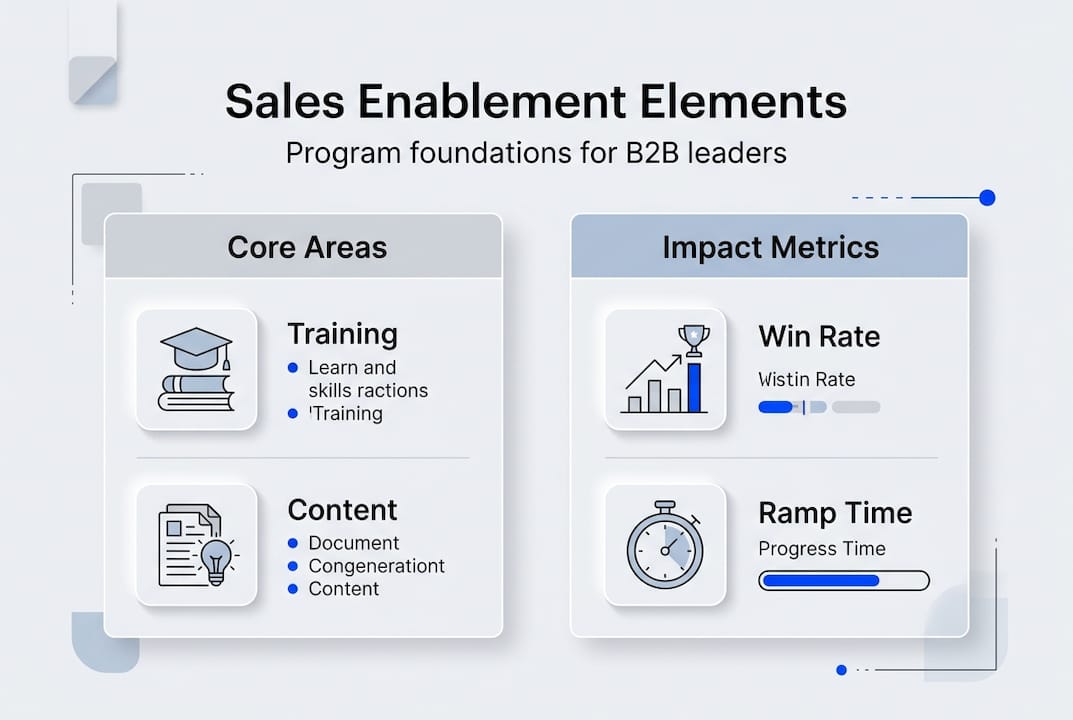
Here is what the data looks like in practice:
MetricWithout structured enablementWith structured enablementAverage ramp time9 to 12 months3 to 6 monthsWin rate improvementBaseline15% to 25% higherTime spent on admin40% of selling timeUnder 20%Revenue growth (12 to 18 months)Baseline10% to 30% increase
Beyond the numbers, the organizational benefits compound over time:
- Consistent messaging: Every rep delivers on-brand, accurate information regardless of tenure or territory
- Faster onboarding: New hires reach productivity in weeks, not quarters, because knowledge is structured and accessible
- Stronger compliance: Governed content reduces the risk of reps using outdated or non-compliant materials
- Better cross-sell and upsell: Reps who understand the full portfolio spot opportunities that would otherwise be missed
- Reduced manager burden: Structured programs free sales managers from constant firefighting so they can focus on coaching
For organizations managing dozens or hundreds of services, pre-sales efficiency becomes a genuine competitive advantage. The rep who walks into a meeting fully prepared, with relevant insights and tailored content, wins more often. That preparation does not happen by accident.
Modern tools and technologies powering enablement
The right technology does not replace good enablement strategy. It scales it. AI-driven tools automate content delivery and analytics for major efficiency gains, which is especially valuable when your team is large and your portfolio is broad.
Leading enablement platforms today offer:
- AI-powered content recommendations: Surfacing the most relevant case studies, proposals, and product sheets based on deal context
- Automated CRM updates: Reducing the administrative burden that pulls reps away from selling
- Meeting preparation workflows: Generating client-specific briefings before every call or visit
- Analytics dashboards: Connecting content usage to deal outcomes so you know what actually works
- Integration with existing systems: Connecting to your CRM, document management system, and communication tools without requiring a full tech stack overhaul
Pro Tip: Adoption is the single biggest risk in any technology rollout. Before selecting a platform, involve a cross-section of your sales team in the evaluation. Reps who help choose the tool are far more likely to use it consistently. Pair the launch with a clear “what is in it for me” message tied to time savings and quota attainment.
For teams managing complex deal cycles, deal execution solutions that automate meeting prep, qualification, and content generation can reclaim hours of selling time each week. The goal is not more technology. It is the right technology, embedded in the workflow your reps already follow.
Exploring AI strategies in sales enablement can help you identify which automation opportunities will deliver the fastest return for your specific team structure.
Best practices for implementing sales enablement at scale
Building a program is one challenge. Rolling it out across a large, distributed sales organization is another. Successful enablement requires executive buy-in, cross-team alignment, and ongoing measurement. Without all three, even well-designed programs stall.
Here are the steps that consistently separate successful rollouts from failed ones:
- Secure executive sponsorship first. Enablement that lacks leadership support gets deprioritized when competing demands arise. Make the business case in revenue terms, not activity metrics.
- Align sales and marketing early. Content created without sales input rarely gets used. Build a feedback loop where reps flag what is missing and marketing responds with targeted assets.
- Phase your rollout. Start with one team or one deal stage. Prove the model, gather feedback, and then expand. A phased approach reduces risk and builds internal advocates.
- Invest in change management. Communicate the “why” before the “how.” Reps who understand the purpose of a new process adopt it faster than those who receive a mandate without context.
- Measure what matters. Track win rates, ramp time, and content adoption. Review the data regularly and adjust. Enablement is not a launch. It is an ongoing practice.
“The organizations that struggle with enablement are usually the ones that treat it as a project with a start and end date. The ones that succeed treat it as a permanent capability.”
For organizations in regulated industries or those managing compliance strategies in B2B sales, structured enablement also reduces legal and reputational risk by ensuring reps always work from approved, current materials. Pairing this with strong account management tools ensures your team stays aligned on account health and opportunity signals across the full customer lifecycle.
Transform your sales enablement with Uman
The principles in this guide, centralized knowledge, structured workflows, measurable outcomes, and technology that fits your existing stack, are exactly what Uman is built to deliver. Uman acts as a sales brain for complex B2B organizations, pulling together your entire service portfolio into a governed data layer that powers every stage of the sales cycle.
With the Uman platform, your team gets AI-driven meeting preparation, automated CRM updates, and proactive cross-sell recommendations without requiring advanced prompting skills or a complete tech overhaul. The deal execution solutions help reps walk into every conversation prepared, and the account management features keep your team focused on growth within existing accounts. If you are ready to move from scattered enablement efforts to a structured, scalable program, Uman is worth a closer look.
Frequently asked questions
What are the main benefits of sales enablement?
Companies with robust enablement see measurable gains in win rates and revenue. Sales enablement improves team performance, accelerates onboarding, and increases win rates by giving reps the right resources and processes at the right moment.
How does sales enablement differ from sales training?
Sales training typically focuses on a specific skill or product knowledge delivered at a point in time. Sales enablement integrates training, tools, and analytics for continuous support across the entire sales cycle, not just during onboarding.
How do you measure the success of sales enablement initiatives?
Measurable outcomes are central to effective enablement. Track sales cycle length, win rate changes, new hire ramp time, and content adoption rates to get a clear picture of program impact.
What technologies are most critical for effective sales enablement today?
AI-driven tools automate and personalize enablement at scale. AI-powered content management platforms, CRM integrations, and analytics dashboards are the most critical technologies for large B2B organizations looking to scale their enablement programs efficiently.
Recommended
Prep like a machine, sell like a human
Let AI handle the research and prep work — you focus on building relationships and closing deals.